The Great Himalaya Trail – in the dusty shade of the yak caravan

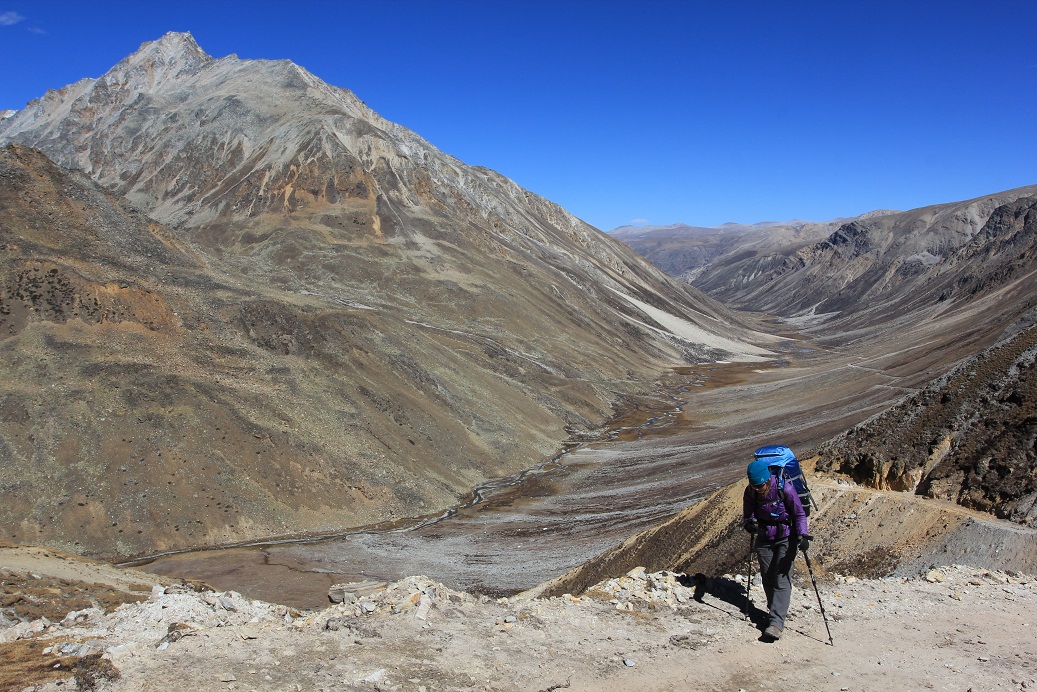
I tighten my cap, swing on the hood of my insulation jacket and zip it at the fullest. The wind is howling straight into my face and I feel some ice christals forming on my ugly, wide beard. To my left, the Lhashamma peak (6412m) is being swallowed by the clouds. The first such weather for weeks. It has been crisp for ages now.

Ascending towards Kagmara La, Dolpo District, Nepal, Himalaya

Ascending towards Kagmara La, Dolpo District, Nepal, Himalaya

I feel like running the marathon, exhausted but still 5km until the finish. Every step up it takes, my lungs cry for oxygen and my muscles cry for help. 200m ascend until the 5100m Kagmara La pass is reached. I’m allready higher then any possible summit in the Alps, but the ridges and gloaming peaks around me just laugh with that thought.

Near the Kagmara La, Dolpo, Shey Phoksundo NP, Nepal

Near the Kagmara La, Dolpo, Shey Phoksundo NP, Nepal

I still cannot distinguish the prayer flags at the pass for which I long so much. A golden eagle swoops without any effort in a thermal. My thoughts swing away back to Simikot, which we left in the hot, baking sun 2 weeks ago, with a compass heading south-east.

A farmer with his cattle herd on the small trails along the Humla Karnali river, Humla, Nepal

A farmer with his cattle herd on the small trails along the Humla Karnali river, Humla, Nepal

We were about to follow the turquoise Humla Karnali-river into the Mugu-district. At lower elevations (we descend into the Middle Hills at around 1500m-2000m), the ever rising and plunging down along the river was easier to digest.

Through the Humla Karnili gorge towards Mugu-district

Through the Humla Karnili gorge towards Mugu-district

Dense, mixed, conifer, birch, oak, walnut and rhododendron forrest are opened up only for some of the most primitive villages we have ever been through. Huge cannabis plants border the wheat fields and spread with a small breeze its deep, sweat smell over the trail.

Dal bhat with fresly dried goat meat, Surkeghat, Humla, Nepal

Dal bhat with fresly dried goat meat, Surkeghat, Humla, Nepal

Time has come to a halt here centuries ago. Children don’t beg for balloons, pens nor chocolates in the villages of Dharma and Rimi. Englishis is an unknown language. It’s half-way october and the fields shine like gold. Harvest is closing-in soon now. This time of the year people can feed themselves (and us). We do not want to imagine how life must be here after winter when all food is gone. Life is harsh here in Mugu. Tourism is below infancy. The Great Himalaya Trail will hopefully boast the region in some way in the coming years.

Children run along, when we walk through Rimi-village in Mugu. They keep chanting namaste untill we dissapear in the forrest far away from the village.

Children run along, when we walk through Rimi-village in Mugu. They keep chanting namaste untill we dissapear in the forrest far away from the village.

The scenery changes with every curve of the river altough in this part of Nepal you will not find the extreme, high 8000m fluted peaks for which the Himalaya is known. Walking here is a flash back in time, where modern world has not touched down yet. People are poor and underdevelopped, but that ever welcoming smile burries ever such taught.

The Mugu Karnali River joins the Humla Karnali further south, dropping out of the HImalaya into the Ganges Plains in India.

The Mugu Karnali River joins the Humla Karnali further south, dropping out of the HImalaya into the Ganges Plains in India.

We cross the suspension bridge over the Mugu Karnali river and step into a dinstinct world. Gamghadi is a radical change. Everybody is preparing for the Dasain-festival. Painting is going on. And a gravel road construction is on the way from Jumla, 3 days walking away. It’s an up and down of mule caravans on the steep forrested trails, transporting out the famous red rice, cultivated in Mugu, and bringing in consumer goods, transported into the region via the only road, which ends in Jumla.

Jumla-streets are filled with goat and sheep blood, as villages people sacrifice for the Dasain-festival, the main celebration of the Hindu year.

Jumla-streets are filled with goat and sheep blood, as villages people sacrifice for the Dasain-festival, the main celebration of the Hindu year.

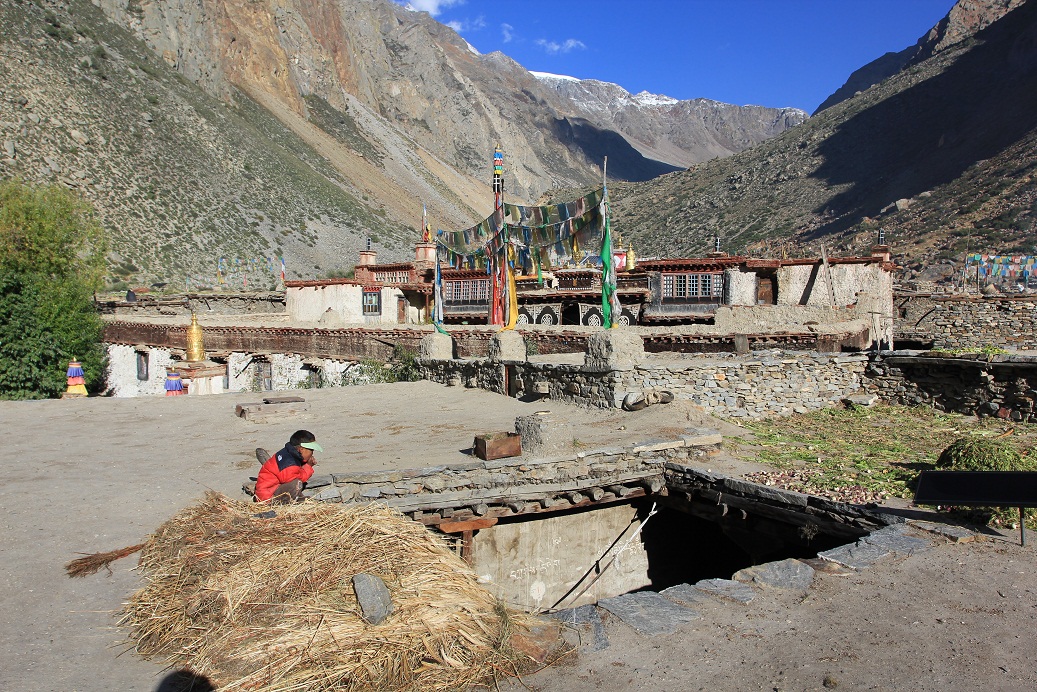
In Jumla we hire 2 new porters before setting of for Nepal’s least inhabited district: the mystical Dolpo. Fortress-like settlements are very scattered, so we need to carry more food and kerosene. Dolpo, like the Limi-valley, is tied culturally to Tibet. Budhism is the way to go. Manis, stupas, gompas and prayer-flag ornated monasteries. Dust-throwing yak caravans are just mere dots in the arid red-rolling mountain desert, set against ever blue skies and radiating sun.

Thick forrested ridges before climbing onto the Dolpo desert

Thick forrested ridges before climbing onto the Dolpo desert

Huge stands of cannabis plants at the entrance of Chaurikot, Dolpo district, Nepal

Huge stands of cannabis plants at the entrance of Chaurikot, Dolpo district, Nepal

Exhausted I reach the 5100m Kagmara La and I fail miserably in limbo dancing the prayer flags (not recommended in thin air). Another steep walled valley splunges down in front of me. This is the Shey Phoksundo National Park, encompassing the major part of the Dolpo district.

Kaghmara Pedi bivaouc, 3900m, Shey Phoksundo NP, Dolpo, Nepal

Kaghmara Pedi bivaouc, 3900m, Shey Phoksundo NP, Dolpo, Nepal

Herds of blue sheep jump the ledges of an impossible steep, granite wall above our bivaouc spot. They are the main food source for the magical, mystical, elusive snow leopard. Under a full moon we fall asleep under the tarp (yes it works in the Himalaya above 4000m!), while the howl of a wolve reminds us of our remote, wild whereabouts.

A wild dog followed us closely for 3 days over the 5100m Kagmara La pass. In the first village we cross, he lost interest in us.

A wild dog followed us closely for 3 days over the 5100m Kagmara La pass. In the first village we cross, he lost interest in us.

We reach the deep, blue Phoksundo Lake at medieval Ringmo village and visit the ancient Bon gompa at its shores.

Bon Gompa at the shores of Phoskundo Lake

Bon Gompa at the shores of Phoskundo Lake

As we still have not enough for this stretch of the Great Himalaya Trail, we cross the 5100m Baga La pass and 5300m Nama La pass in a tyring and cold 48-hour stretch. The scenerey get more arid with every step we take now. As for high altitude desert, they surely have thrown with superlatives here. It is hard to soak on in all the views here. My brain is too small for this huge landscape.

Leaving Ringmo village, with an impressive stupa garding its entrance

Leaving Ringmo village, with an impressive stupa garding its entrance

The fluted Kanjiroba Himal to the northwest hides the world’s remotest valleys for which we should return one day when its acces permit hopefully may be less steep. At the southern horizon 8000-peak Dhaulagiri blocks the monsoon rains and to the north the vast Tibetan plateau still awaits its freedom.

Yak caravan storming its way down from Baga La, 5100m, Phoksundo NP, Dolpo, Nepal

Yak caravan storming its way down from Baga La, 5100m, Phoksundo NP, Dolpo, Nepal

Collecting specimen of Thamnolia vermicularis Lichen for the Adventure & Science project

Collecting specimen of Thamnolia vermicularis Lichen for the Adventure & Science project

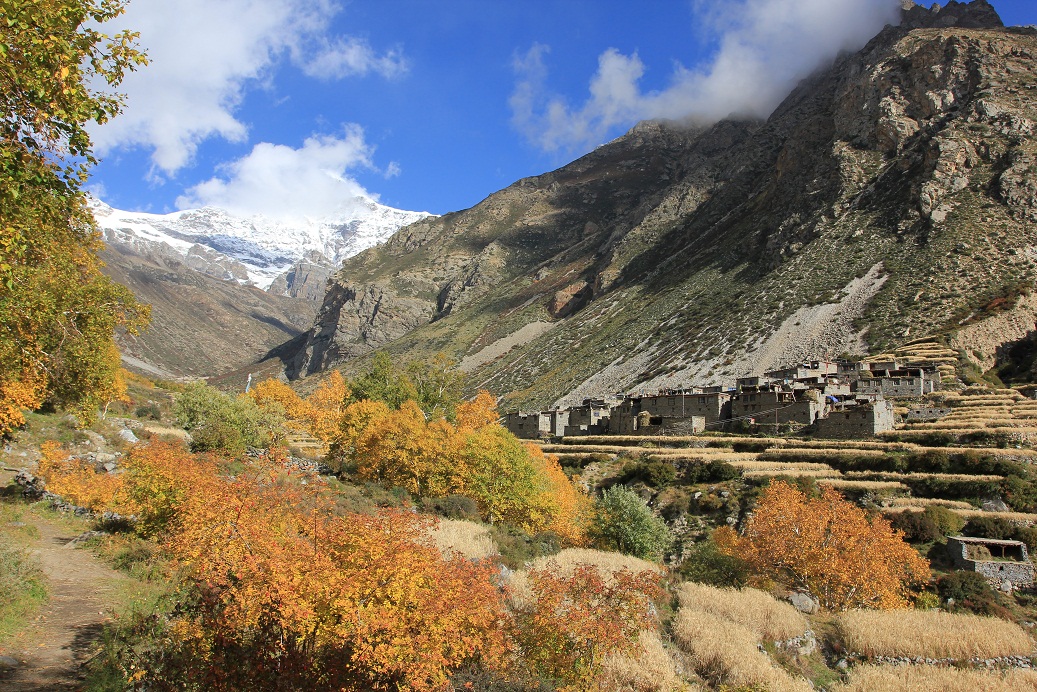
We plunge into the Tharap valley, which must be the perfect resume of what forbidden Tibet must be all about. A steep, wild gorge brings us back to thicker air and greener valleys where a flight from a frightning airstrip in Juphal brings us back to the lowlands and into the splurges and hot shower of Kathmandu.

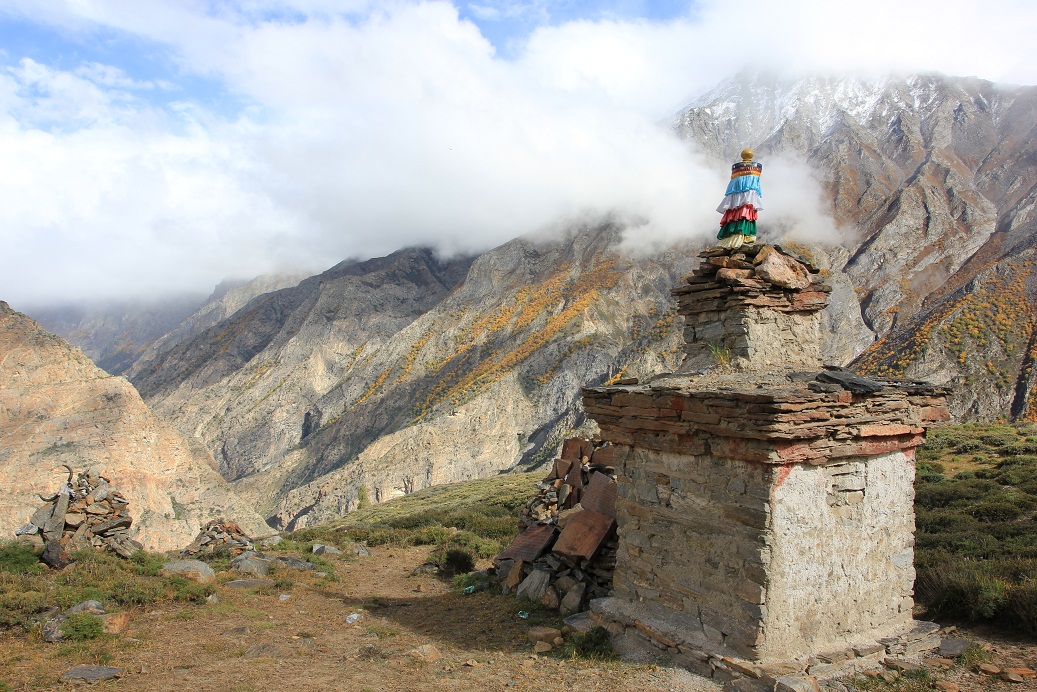
A dusty yak route into remote Tibetan Dolpo

A dusty yak route into remote Tibetan Dolpo

The Dhaulagiri-chain blocks the monsoon rains from the south

The Dhaulagiri-chain blocks the monsoon rains from the south

The impressive Ribo Bumpa Gompa, high above the Tharap Valley, Dolpo

The impressive Ribo Bumpa Gompa, high above the Tharap Valley, Dolpo

We are gearing up for a 5-week Rolwaling-Khumbu Alpine traverse for which we will need to cross glaciated 5750m Tesi Lapcha, 5780m Amphu Lapcha and 5415m Mera La passes. On the way we do an attempt on 6476m Mera Peak.

See you back here around X-Mass.

Namaste
Steve and Katrijn

Thin air dreamers...

Thin air dreamers…

Please have a look in our online photo album from our first 6 weeks in West-Nepal.
You can still follow us real time up here.

The Great Himalaya Trail – a pilgrimage of the soul

Buckle up, earplugs in. A deafening roar. A breath away we hoover in a small twin otter above the fog between steep forested mountains. The rising sun blinds our eyes through the small cockpit windows. 2 pilots. 5 passengers of which 2 dreamers for mystical high valleys and roaring peaks.

Main Bazar of Simikot, capital village of Humla District

Main Bazar of Simikot, capital village of Humla District

A 50 minute, impressive flight would bring us from the hot and soaking lowlands into the heart of remote, western Nepal. Right into the heart of the world’s highest mountain chain. The Himalayas. Before we realize, we see an airstrip appear through the cockpit’s window. Touch-down Simikot. At almost 3000m asml, the capital village of Nepal’ highest, northernmost and most remote district Humla.

Smokin' fresh tobacco from the fields

Smokin’ fresh tobacco from the fields

The sprawling village has no road access. It takes 14 days walking to the closest road head. This closed-off corner of the world, deep in the Himalayan mountains is carpeted with centuries-old migration paths in and out Tibet, just a stone throw away.

Pen. Chocolate. Mister. Mister...

Pen. Chocolate. Mister. Mister…

We have the intention to backpack in 3 months a considerable distance of the Great Himalaya Trail, which is in contrast to famous long distance trails in Europe or the States, more a suggestion for a traverse along the world’s highest mountain chain, extending through Pakistan, India, Nepal and Bhutan. The “trail” is an unmarked nor signposted route of which you pick and mix your way out of the web of paths through and over the roof of the world.

Colourfull women in Daurapiri, Humla Karnali

Colourfull women in Daurapiri, Humla Karnali

The philosophy behind the trail is to attract trekkers to more remote parts of the Himalaya, where tea house trekking is till a far away known. Its goal is to attract visitors to under-developed and impoverished areas where only few alternative development opportunities exist.

Visiting the doctor in the Health Office from Nepal Trust in Palbang

Visiting the doctor in the Health Office from Nepal Trust in Palbang

We have chosen to explore the more forgotten and hidden valleys, passes and peaks, with the intention to support the local people as much as possible. We did not bring a an expedition crew of porters, carrying kitchen tents and food from far away to cook on campsites in between the villages.

Yak caravan. Humla Karnali.

Yak caravan. Humla Karnali.

In stead we come lightweight, in-Himalayan style, carrying our own gear. Ram, our guide, leads us through the web of ancient old, bad mapped caravan routes and to handle language barriers with all the different ethnic groups of which cultural differences vary from one valley into another.

Climbing up to the Limi Valley with the Hilsa border post down-valley

Climbing up to the Limi Valley with the Hilsa border post down-valley

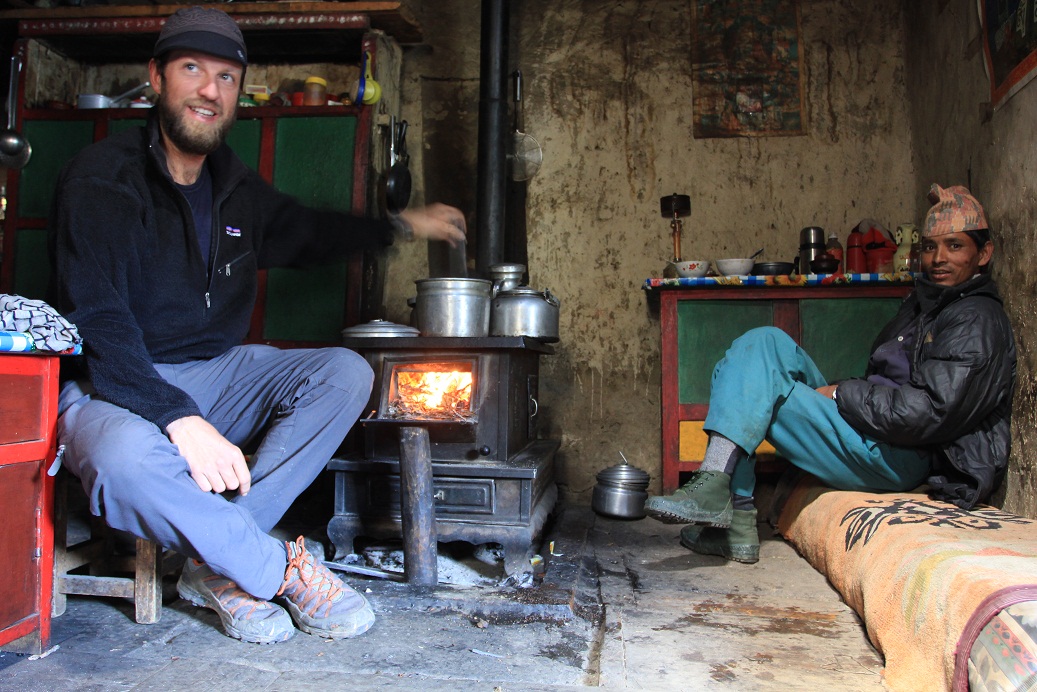
In the spirit of the the Great Himalaya Trail, we will stay as much as possible with the people, share their table and sleep in their room or on their roof. In the far western part there is nothing yet resembling a tea house or anything worth naming a tourist facility.

Trails carved up impossible steep valley walls, Limi Valley

Trails carved up impossible steep valley walls, Limi Valley

More then once we are invited to stay with families who never had a stranger over the floor. Sometimes distance between the villages would be more then a day walk away so we hire a local porter for carrying some camping food into thin air and wind swept passes.

Charten, high above the Limi Valley

Charten, high above the Limi Valley

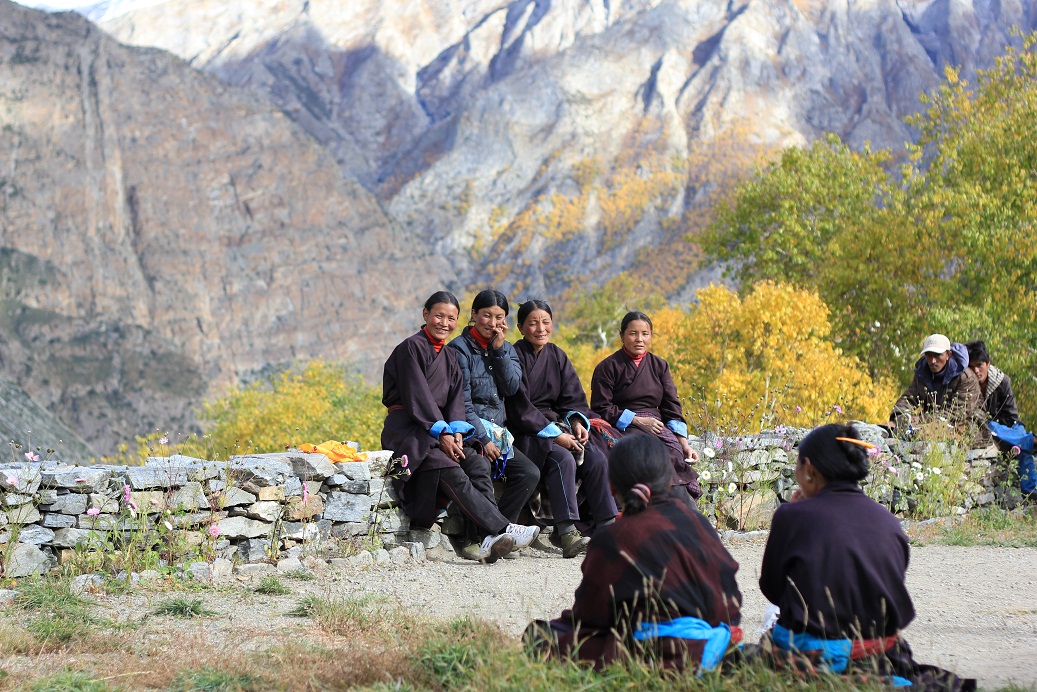
We follow yak and mule caravans towards the Tibetan border through the fertile Humla Karnali valley, along medieval stone-build villages. The sound of the wind is broken by women chanting ancient Tibetan songs while harvesting the barley fields. We’d greet “Namaste” to young men wearing the “HortN” Face (no kidding!) jackets and send off “pen” and “chocolate” begging children to school.

Yak butter thea? Noboddy?

Yak butter thea? Noboddy?

The sun burns our pale skin while air is getting thinner. In Hilsa, at the border with Tibet, Nepali’s most northwestern border point with Tibet and Nepali’s Great Himalayan Trail western entry point, we swing up even more north into the Limi Valley, only open to foreigners since 2002. A steep trail is cut high up into an impossible looking valley wall, high above the roaring Karnali river.

Rooftop terrace. Til village. Limi Valley.

Rooftop terrace. Til village. Limi Valley.

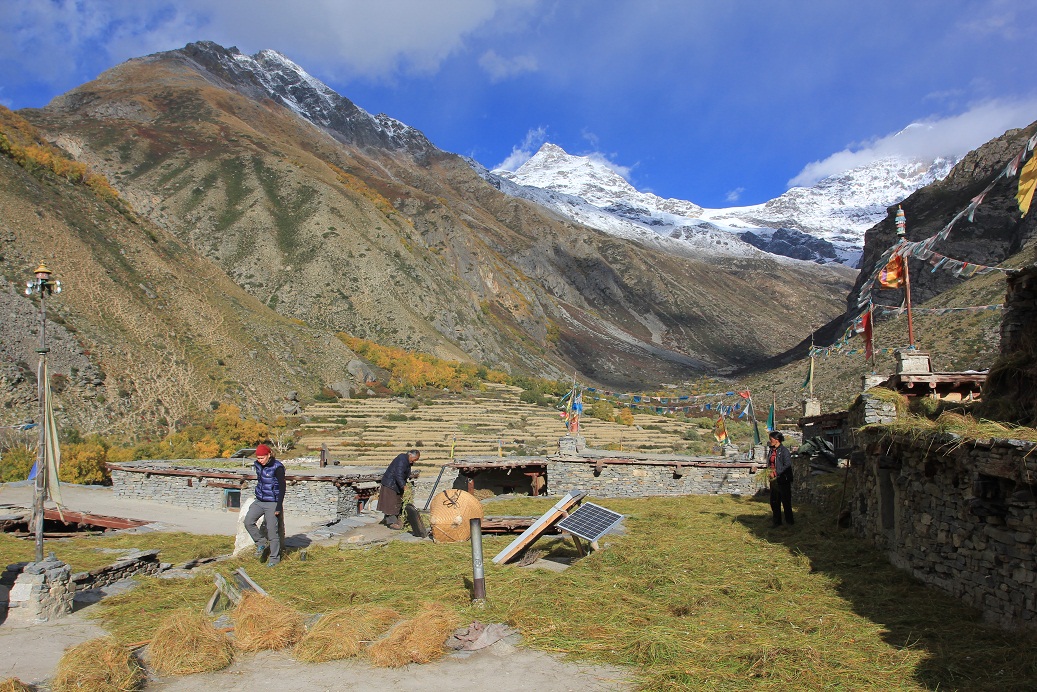
These steep mountains didn’t stop human looking for living grounds but surely it kept industrial revolution get through. People live on the rythm of day and night, living to live and survive on their own. Development stopped here a couple of centuries ago. Til, Halji and Jang represent villages out of medieval times.

Women of Til village, awaiting the school sponsor

Women of Til village, awaiting the school sponsor

Kids would flock around us and touching us endlessly as we were new toys when we enter the villages. In Til and Halji we sleep in the house of the Lama and visit their 5 centuries old, impressive monasteries.

Til village. Shangri-La?

Til village. Shangri-La?

We encourage the work of some NGO’s, building primary schools, health offices and micro-hydro and solar power into these villages. But in our short time here we discover pathetic flaws into some of their work. Building a health post stocked with pills and to post the place with a flew-in doctor a couple of weeks a year will make things better right?

Children of Halji. Limi Valley.

Children of Halji. Limi Valley.

Close to the health post of Hilja, down by the Karnali river, we discover remnants of half-burnt stacks of out-of-date pills in easy reach of children’s hands. A sign at the health office promises to bring basic health education here but in the village the families don’t have even the slightest clue about basic sanitation. Toilet? Euhm. Out of the village, down by the river. We’re 10 years behind the inauguration of the health office…

Impressive 500-year old Gompa. Halji village. Limi valley.

Impressive 500-year old Gompa. Halji village. Limi valley.

Building a primary school with foreign money. Check. An educated teacher. Check. School furniture. books and utensils. Not so always check. The “sponsor” is doing his yearly tour along the villages. A nice good-looking American, handing out useful and not so useful gifts. Continuing to the next village. Nice? Euhm. But why not checking if the kids really have learn something?

Waving goodbye. Children of the head lama of Halji village. Limi Valley.

Waving goodbye. Children of the head lama of Halji village. Limi Valley.

Solar panels and micro-hydro power. A couple of years later. Half of it in decay. Continuation? And that while famous NGO-representatives sipping expensive bears and chicken wings far away in their nicely built office in Simikot.

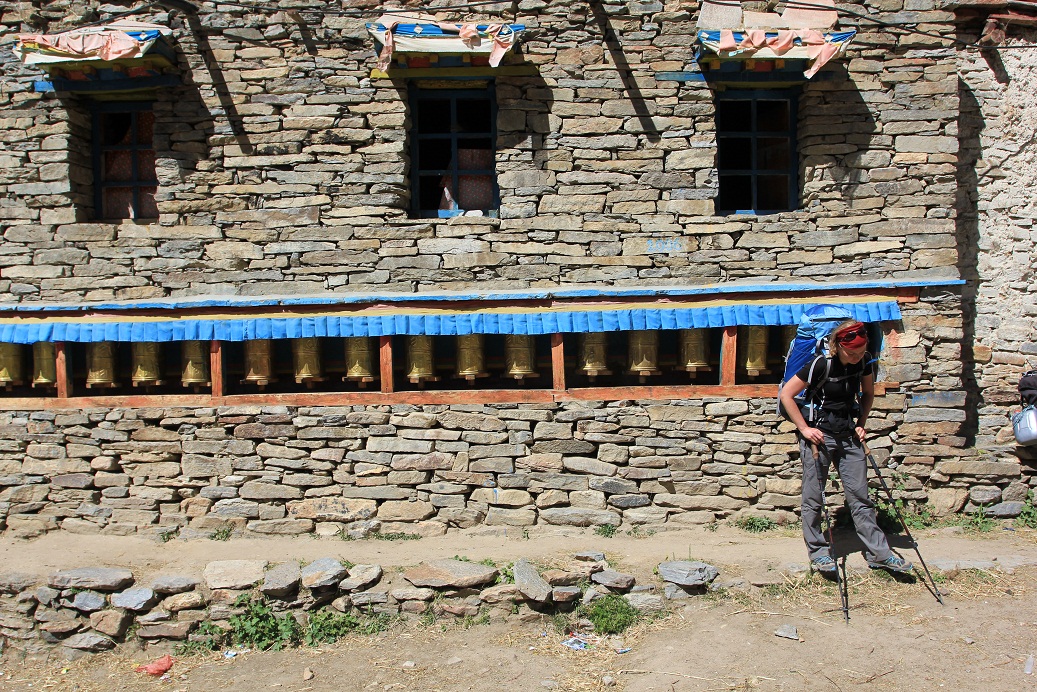
Prayer Rolls at the entrance of Yang village monastery. Limi valley.

Prayer Rolls at the entrance of Yang village monastery. Limi valley.

Incredible Milky Way. Bivaouc at the foot of Nyula La pass (5000m).

Incredible Milky Way. Bivaouc at the foot of Nyula La pass (5000m).

River crossings. Still awesome. Especially at 4500m asml.

River crossings. Still awesome. Especially at 4500m asml.

Rural Nepal, ranked in the top 10 of poorest parts in the world needs true and continues development. It needs honest NGO’s with an honest, lasting plan. And a stable, corruption-free government. There has been done great work here, but still…
It all starts with educating the people, young and old.

Climbing up to Nyula La (5000m). Tibetean plateau in the background.

Climbing up to Nyula La (5000m). Tibetean plateau in the background.

Coming down from Nyula La (5000m). Unscaled, unnamed virgin 6000m peaks in the background.

Coming down from Nyula La (5000m). Unscaled, unnamed virgin 6000m peaks in the background.

Heading down back to Humla Karnali Valley.

Heading down back to Humla Karnali Valley.

We’re only 14 days off in the Nepali Himalaya. It already carved a deep impression. It’ a pilgrimage through the highest mountains and deepest valleys of the soul.

We’re heading east now. Into Mugu and Jumla and through Dolpo.

Namaste.

Steve and Katrijn.
Dreamers on the go.

Dreamers on thin air. Humla Karnali. Nepal.

Dreamers on thin air. Humla Karnali. Nepal.

You can still follow us real time up here.

Lappland – a summer’s long ramble through Europe’s last wilderness

“It has been the worst summer in 20 years”, laughs the Sámi when we climb up into the clouds above Tromsø. We’re 350km north of the Arctic circle. Sharp mountains cliff out of the Nordic Sea, overstraining the neck muscles, when scouting for the craggy summits.

The backcountry above the city of Tromso, a wilderness a stone throw away

The backcountry above the city of Tromso, a wilderness a stone throw away

It’s mid summer, but rain pours down. 5°C. A light breeze from the west. On the map, a “route” is drawn in dotted lines. It’s supposed to be a trail right? Must be easy. I’ve been studying maps for weeks and on google earth, behind the save gloam of my laptop. Big plans on foot and packraft. 55 days. We could do easily 1000km, right?

Micro flora, Øvre Dividal National Park, Norway

Micro flora, Øvre Dividal National Park, Norway

After a couple of km the trail peters out in a smelly, squishy marsh. The kind of nice soil we would encounter a million times on our rambles the coming weeks. We wear mesh trailrunners with a thin liner. Within a breath, the water soaks around our toes and ankles. Sulking lips. Quickly a cold shivers up our legs. Lightweight footwear. That’s less tired legs and body. That’s why we choose to walk in them. And they have 1 big advantage over classical boots: they dry quickly. Duh. Especially in bloody marches. Ahum. There would be more nice talks about lightweight backpacking and packrafting in the coming weeks.

A hot, dry summer in the North

A hot, dry summer in the North

Welcome in the Far North. Fjells. Mountains. Marshes. Lakes & fish mashed-up rivers. Neverending virgin forrest, sheltering abundant wildlife. And mosquitos. Altough they are not as abundant as expected. The worst summer in 2 decades. It has its advantages. Still we were happy with our nest under the tarp, protecting us from the scrumptious blood sucking from above and soaked mother earth from beneath.

A lightweight pack? Not with a packraft on top :-S

A lightweight pack? Not with a packraft on top :-S

After 5 days walking in our neoprene socks over tyring marshes, bushwalking through thick undergrown birch forrest in low cloud and continuous drizzle, unable to follow the so called “trails” on the map, we were allready behind “schedule” at the foot of the Lyngen Alps. Morality was disgraceful. We bailed on our initial route of packrafting and hiking through these craggy, fjorded mountains. The weather was depressing, to say the least.

To Lyngen or not to Lyngen

To Lyngen or not to Lyngen

At its southern most point, we left the fresh sea air from the deep fjords in the Lyngen and treaded on south in direction of the Swedish border. We had a new goal: packrafting our first Laponian river: the Kummaeno. Further from the coast, the mountains get bald and more rounded, the valleys widen up, breaking up into the barren, windswept tundra. It was the first week of August, we soaked our first real sun rays as we blew up the packraft for our first float above the Arctic Circle. The Kummaeno, probably Sweden’s most northern stream worth naming a river, becomes wide enough after an impressive waterfall, near the STF Pältsa Fjällstuga. The setting is beautiful, we’re eager to float off, but emerging rocks on the surface betray floating problems. A couple of minutes after setting of, we’re allready stuck on the banks. Low water. Anglers seem photographing our struggle, way more interesting then catching the precious Laponian salmon.

Arctic char, proteins from the wild

Arctic char, proteins from the wild

Halfway the 30-km long river we bail, sick of getting in and out for low water and impossible rock gardens. Two of us plus expedition gear weight in one packraft, will probably only work out on slow flowing, high volume rivers and big open waters. The idea of gettings stuck on a similar river a couple of days hiking south from here, make us decide to reroute our inintial plan and stay closer to the Swedish-Norwegian border, up in the mountains. Emotional rollercoasters reign supreme. The big plan. Tsssss. More changes on the way.

Going for fish. Vuoma lake. Øvre Dividal National Park, Norway.

Going for fish. Vuoma lake. Øvre Dividal National Park, Norway.

We end up hiking through stunning Øvre Dividal National Park, with its wild roaring rivers, ripping open the granite curst of the mountains into deep canyons, covered with thick birch forrests. Canyons give way for rolling plateaus, where we enjoy our first real clear crips day of the ramble so far.

Packrafting the vast Altavatnet, Lappland, Norway

Packrafting the vast Altavatnet, Lappland, Norway

We find an old, used fishing rod in the shed of a DNT mountain cabin near the Vuoma lakes. With some fixed line, a hook and some rain worms, we got from 2 sympathetic Germans, we paddle across to the outlet. We had never fished before, except for the odd-afternoon-out with friends and beers for catching trout in farmers puddles in our Belgian backyard. Arctic char is fighting it’s way up on the second bend after the outlet. She holds the rod, me throwing in the line from the banks. Within an hour we catch 5 nice, neat Laponian fish. We feel like Grizzlies feasting on the runs. That night it was party times.

Arctic sunsets... oe-aaa-addictive

Arctic sunsets… oe-aaa-addictive

By the time we reached Abisko, the popular starting and ending point for the Kungsleden, August was almost half way. The one and only (!) high pressure of the summer settled above the Laponian mountains. It would hold for 5 days, of which we spent 2 days in the city for logistics purposes. Bummmer.

Áhkká, proud garder of Laponia

Áhkká, proud garder of Laponia

We hurried into the heart of Laponia, at the gates of Sarek NP, where the Áhkká-massif still proudly gards Europe’s last remaining wilderness area. Nice to meet you naked and undone from your winter coat this time. Enjoying the mosquito’s? We rambled into the heart of the ever impressive park. We entered by the same valley we did last winter. Instead of the obvious winter white we were awed by wildflowers adorned meadows, carpeted with concentrated stands of polar whool, betraying the boggy areas.

Bivaouc in the Sarek NP, Laponia, Sweden

Bivaouc in the Sarek NP, Laponia, Sweden

Herds of raindeer would compact on summer end’s remaining snow fields and with the flip of a coin they would move from one impossible sheer cliff into another as they were 1 animal. We bivaouc on scenic lookout spots and enjoy the clouds seducing the mountain crests and summits. We packraft ever impressive Bierikjarve lake and explore its surroundings. We are struck by nature’s beauty on this alpine splendeur.

Bieik Jarve, Sarek NP, Laponia, Sweden

Bierik Jarve, Sarek NP, Laponia, Sweden

We cross milky glacial tributaries and regret we did not put on the neoprene socks, tucked away deep in the pack. We try our luck on some summits but are chased down multiple times as cloud and rain swallows our joy and view. Respect the mountains. Sir, yes sir.

Algavagge, Sarek NP, Laponia, Sweden

Algavagge, Sarek NP, Laponia, Sweden

We can spend a lifetime here. A lot of mysterious valleys, rivers and peaks to explore. This corner of the world really know how to bite in one’s spirit.

Arctic stream crossing, I love the feeling

Arctic stream crossing, I love the feeling

An evening bath in Sarek NP, Laponia, Sweden

An evening bath in Sarek NP, Laponia, Sweden

Normally this story should continue with our ramble into Padjelenta and up to the Norwegian coast. We’re almost halfway our packrafthike through Lappland, but my typing and photo-editing time is up.

We’re in Kathmandu, Nepal right now. We’re finishing up logisitics for the first leg of a 3-month trek in the Nepal Himalaya. First up is a 45-day trek which we start tomorrow. It will takes us roughly along the Great Himalaya Trail and take us through Humla, Mugu and Jumla and through Dolpo.

To end, some pics from the second half of this trip report, coming up later this year. Or next year… Probably going to spend too much time outdoors the next 10 months. We’ll see. I have +1000 Lappland pics to edit and I have a lot of footage for a time-lapse movie of our 8 week Lappland packrafthike. I promise I will release it through here…

The provisional photo album is found here.

You can still follow us real time up here.

It’s time for another adventure. It’s time to hit the trail. Again.

Peace out.

Steve and Katrijn

Bivaouc on the Skierfe-ridge, Sarek NP in full autumn glory

Bivaouc on the Skierfe-ridge, Sarek NP in full autumn glory

Packrafting in Rapadalen Delta, Sarek NP, Sweden

Packrafting in Rapadalen Delta, Sarek NP, Sweden

Packrafthike gapyear – family farewell, gear list, adventure and science

Last stressy weeks at work. Nightly gear, logistics and route check-ups. Preperations got accelared. Hectic at times. Eventually the day arrives you shake hands with your colleageus. “See you in 400 days” with a deadpan grimace.

Walking on a ridge on the wild northeast coast of Tenerife

Walking on a ridge on the wild northeast coast of Tenerife

2 weeks before we leave on our expeditions to Lapland we go on a close-to-home farewell weekend-trip with Katrijn’s family. Eat, drink, bike, walk, laugh, fun. Immediatly followed by a 10 day family trip to the volcanic island of Tenerife with Steve’s family. A trip to a holiday resort island, which attracts 5 million tourists a year? Not our kind of destination you’ll think. But the island had more to offer then what we came for, watch the video impression…

.

What do you take on such a 55-day packrafthike in the subarctic?

Well, here is our gearlist for download, or click on the picture below. This is our full skin packlist, calculated with 10-day food ratio stretches. Is this ultra lightweight? Not in a distance. It’s lightweight in our mind with subarctic, mosquito-laden, summer-autumn climate conditions in mind. And some comfort too. Andrew Skurka’s blogpost on Stupid Light, just came in time to stop us from gram hunting 😉 I could write a full blogpost on our gear. Can you wait for a year?

Gear List Packrafthike Lapland - 1100km

Gear List Packrafthike Lapland – 1100km

Adventure and science

Not working for a year. You lazy horse. Why not combining all this with some voluntary usefulness for society. That’s why we shaked hands with Adventure and Science. This NGO facilitates partnerships between adventure athletes and the researchers who need them to collect data all around the world. From Mt. Everest to the Ocean, they have asked hundreds of athletes to make their time outside more meaningful. All of them become volunteers and make the decision to become adventurer-scientists because they have a strong desire to make more of their expeditions.

Adventure and Science

Adventure and Science

On our 1100km subarctic Lapland expedition we will be working for the Evolutionary Biology department from the Uppsala University in Sweden. We will do field data collection on Lichens, which are symbiotic organisms between a fungus and algae. Even if they are very important members of an ecosystem, their life cycle and biology is very little understood. Thamnolia vermicularis lichen grows all over the world in alpine and artic environments. It was not discovered yet in Africa or Antarctica but there is o reason it should no grow there. Because is an asexual species its wide distribution is quit a mistery among biologists. Some consider this lichen a very old species dating from Permian-Triassic when the Pangea continent still existed. Other think is spreading by birds, or by air currents. In lichen world this dispute is quit intense. By using a genetic approach (extracting DNA from it) scientists will be able to make a phylogenetic tree and solve its mistery. More then that the answers of this investigation will also help scientists and nature conservation people to understand the lichens migration patterns and their biology.

We are choosen as the first adventurers who will collect these species on such an expedition. It’s an honour.

Click for report and video on Joery's blog

Packrafting Grensmaas, last rehearsal before Lapland expedition. Click on picture for report and video on Joery’s blog

Oooh, before I forget, on the last weekend of June, we got a very nice, last minute, 24-hour packrafting trip wit Yves, Michael “Andreas” Jackson and Joery. Please visit his blog for a report with a nice vid. Joery is leaving in August for a 5 week wilderness packrafthike into the Mackenzie Mountains. Allready looking forward to his report!

We are ready. This is it. Let’s get the heck out of here. See you in September, when we are home for 3 days before leaving for the Great Himalayan Trail in Nepal.

Click here for live updates from our SPOT GPS Satellite Messenger

Click here for live updates from our SPOT GPS Satellite Messenger

Packrafthike Gap Year – Part 1/The Subarctic

[Update Tuesdag 11 July 2012 – MAJOR UPDATE on the first Sarek part, where we choose to cut through in western direction in direction of the Norwegian coast, right through Padjalenta National Park, packrafting the anciant glacial lakes of Virihaure, Vastenhaure, Sallahaure. 2 more days added on Lofoten. 2weeks till kick-off. First we’ll have a 10-day family retreat on Tenerife (Canary Islands). Download the full google earth map below]

Seamsealing the MLD eVent rain mitts, a monastic work.

Seamsealing the MLD eVent rain mitts, a monastic work.

We would like to present Part 1 of the Gap Year. A 1102 km packrafthike in Norhern Sweden and Norway. All above the Arctic Circle, wider known as Lapland or Sápmi . 745km hiking. 357km packrafting. 55 days. Kick-off 25th July. Finale 17th September.

The first part includes passing through known and less known areas like Tromsdalen, the Lyngen Alps, Kitdalen, Breiddalen, packrafting Kummaeno, Taavaeno and Lainio in remote Northern Sweden, smashed in between Finland and Norway. A second part will bring us to the famous Kebnekaisefjällen in the Swedish fjells along the Kungsleden, packrafting south, passing a first time through Sarek, westwards through Padjalenta. There we will ferry towards Versteralen and Lofoten. Those islands sparked us with so much eager last year, that we had to come back for some packraft-floating in between the needle-like granite peaks emerging from the sea. We will ferry back towards mainland, from where we will traverse the Svartissen and Salfjellet National Parks in coastal Norway. We will cross back to Sweden in eastwards direction towards wildlife-cladden Taradalen, from where the ruska (autumn) coulours will daze us. From here we will enter a second time into Sarek with an intention on packrafting Rapadalen.

We expect subarctic, summer-autumn climate conditions : ****-loads of misty rain, snow, cold, low clouds on the windswept tundra, arctic mountains and a mosquito-laden taiga. Hopefully some sun too. Would be nice. Thank you.

Please click here for a google earth download file from the 55-day plan. We embed the map in google maps below, but google maps crops everything in 3 different pages, so you don’t have the full picture here.

We would appreciate it a lot, if people known to and from the area, and especially on packrafting some of the rivers, fjords or seas, if they could give us some feedback through the comments. Maybe we overexagerate on some (packrafting) parts of the plan. Or maybe we should reconsider alternatives, on which we did not set our eyes on. A gear list will appear here soon too.

Packrafthike Planning Lapland 2012

Packrafthike Planning Lapland 2012

50 Days Food Rations Preperation

50 Days Food Rations Preperation

We known the area only from winter trips. We were on the Lofoten last year. Loads of pics will follow. We hope.

Utakleiv Beach - Lofoten Islands (from our april 2011 visit)

Utakleiv Beach – Lofoten Islands (from our april 2011 visit)

Reine, probably the world's most photoscenic village. Southern Lofoten Islands (from our april 2011 visit)

Reine, probably the world’s most photoscenic village. Southern Lofoten Islands (from our april 2011 visit)