The Great Himalaya Trail – up and down is the new flat

Weather changing“, Nima Sherpa mumbels in the freezing morning, nodding in direction of snowfluted Bigphra Go Shar (6729m), rising sharp up behind our airy bivaouc spot on a rocky outcrop at 5000m in the immense Drolambu icefall. Clouds of snowdust blow over the ridge on the rythm of heartbeats. Not even a breeze up here. Sun rays set the highest peak agloam. The librarian silence is only broken by huge roars of invisible avalanches coming down the Gakoshir Himal.

A clean slate. After a good rest in Kathmandu, we left for a 5-week stretch into the Rolwaling and Khumbu.

A clean slate. After a good rest in Kathmandu, we left for a 5-week stretch into the Rolwaling and Khumbu.

Durbar Square, Kathmandu. A Unesco World Heritage site.

Durbar Square, Kathmandu. A Unesco World Heritage site.

The Rolwaling Himal lies to the west of the world-reknown Khumbu, hosting the world’s highest one called Everest. This remote valley, skirting the Tibetan border provides a wild and potential dangerous access route into its famous neighbour district through the glaciated and airy Tesi Lapcha pass (5755m).

The Hindu festival of Tihar, also known as the festival of lights, is considered to be of great importance as it shows reverence to not just the humans and the Gods, but also to the animals like crow, cow and dog, who maintain an intense relationship with the humans.

Framed or frameless? That's not the choice for a Sherpa porter hauling up consumer goods into touristy areas like Khumbu. 80-100kg is the norm. The record carried weight by one porter is 180kg, hauled from Lukla towards Namche. A 14km, 1300m up and 700m down hike. They receive 40 Nepali rupees per kg carried. That's 0,5 US$.

Framed or frameless? That’s not the choice for a Sherpa porter hauling up consumer goods into touristy areas like Khumbu. 80-100kg is the norm. The record carried weight by one porter is 180kg, hauled from Lukla towards Namche. A 14km, 1300m up and 700m down hike. They receive 40 Nepali rupees per kg carried. That’s 0,5 US$.

The aproach towards the feared pass is of an unsurpassed beauty. The Rolwaling valley is walled by tremendous steep granite faces culminating in snowfluted crests and peaks like Garin Shankar (7195m), Tsoboge (6689m) and Chekigo (6257m). The area is protected in a conservation area, acting as a wildlife corridor between Langtang National Park and Sagarmatha National Park.

Approach through untouched virgin forrests in the Rolwaling Gorge.

Approach through untouched virgin forrests in the Rolwaling Gorge.

A roaring torrent thunders through virgin forrest, hosting, among the greater himalayan species, swinging families of monkeys which would almost snap my hat while they sway down from the canopy in curiosity for the passing strangers through their untouched habitat. Walking up here, reminds us of untouched valleys in far away Central-Patagonia.

Looking west through the Rolwaling, leaving the only important settlement Beding (3700m) behind. Garin Shankar (7195m) towering high above.

Looking west through the Rolwaling, leaving the only important settlement Beding (3700m) behind. Garin Shankar (7195m) towering high above.

The valley has only one settlement worth mentioning, Beding. The village is perched against the lower grantie wall of Garin Shankar Himal above a colourfull monastery. We cross into more then one Sherpa who are missing one or multiple fingers, a tragic reminder of cruel ascents. The Sherpa of our lodge scaled Everest 8 times an was Messner‘s climbing Sherpa during multiple of his non-solo ascents.

Bivaouc in the side moraine of Tsho Rolpa glacial like at 4580m. Chekigo (6257m) rising behind.

Bivaouc in the side moraine of Tsho Rolpa glacial like at 4580m. Chekigo (6257m) rising behind.

Beyond Beding, the V-shaped valley opens into an U-shaped one. Green is waved goodbye. Grey and white is welcomed. A huge moraine wall blocks of the immense, milky glacial lake of Tsho Rolpa at a lofty altitude of 4580m. The hurling speed of which the feeding Trakarding Glacier is melting, makes this vast body of water a gigantic time bomb, which one day will cause a devastating GLOF, turning the valley further down in a nightmare out of proportions. Thank you global warming!

10, 9, 8, 7, 6, 5, 4, 3, 2, 1. Tuuuut. Click. Tsho Rolpa (4580m) with Trakarding Glacier and Drolambu Icefall loaming behind .

10, 9, 8, 7, 6, 5, 4, 3, 2, 1. Tuuuut. Click. Tsho Rolpa (4580m) with Trakarding Glacier and Drolambu Icefall loaming behind .

Struggling through the chaotic debris on the Trakarding Glacier towards the Drolambu Icefall.

Struggling through the chaotic debris on the Trakarding Glacier towards the Drolambu Icefall.

Approaching the Drolambu Icefall.

Approaching the Drolambu Icefall.

Our simmering gas stove melts crushed ice chunks from the steep ice gully we’re about to climb through to reach the snowy flats of the side moraine of the Drolambu ice. Tucked in all my layers, my eyes peek through the tent zippers and are attracted to the small yellow dot on the grey chaos far below. The Trakarding glaciar fills the whole valley ahead. Tsho Rolpa doesn’t give a wrinkle. Scattered dust clouds betray that parts of the side moraine have given way to gravity and have spitted out their rock and dust to the Trakarding.

The Trakarding Glacier (4700m) as seen from our airy bivaouc spot at 5000m in the Drolambu Ice fall. Can you spot the yellow dot, betraying the Swiss team's position?

The Trakarding Glacier (4700m) as seen from our airy bivaouc spot at 5000m in the Drolambu Ice fall. Can you spot the yellow dot, betraying the Swiss team’s position?

Yesterday we overtook a team of 4 Swiss alpinists on the way to Pumori (7161m) with in their wake a huge expedition crew of overloaded porters, hauling kitchen and toilet tents, keresene stoves, tables and fresh produce. We’re happy we have chosen the fast and light aproach of a small team with 1 climbing Sherpa guide and 2 porters, carrying our climbing gear and food. When I zipped the tentdoor under the rising moon last night, I still distinguished a worrying amount of wavering headlights crawling their way through the dangerous labyrinth of boulder debris on the Tarkarding towards the place where I noticed the yellow dot just before dusk.

Towards the  Teshi Labcha (5750m), which is perched just out of sight here, but below the triangular rockband below the pyramidal Teng Ragi Tau (6943m)

Towards the Teshi Labcha (5750m), which is perched just out of sight here, but below the triangular rockband below the pyramidal Teng Ragi Tau (6943m)

An easy scramble throught the steep ice gully in the icefall puts us on the vast Drolambu glacier. Nima was right. “We to move quickly” he maunders in his broken English. The windchill takes a huge plunch. An intermediate breeze turns into constant windblow. The first clouds appear and move in a hurling speed over the pyramidal Teng Ragi Tau (6943m) ahead. I’m scanning around in search for the sound of the jumbo jet I mean to experience from close range. The wind funnels its way over the Tesi Lapcha Danda ridghe through our aimed pass. That’s mean we’re gonna fly.

Hard work towards  Teshi Labcha (5750m). The Drolambu glacier down below.

Hard work towards Teshi Labcha (5750m). The Drolambu glacier down below.

We rope up and strap on the crampons. The scenery is mindblowing and only rivaled by what we experienced on the traverse we made over the Biafo and Hispar glaciers in the Karakoram mountains in Pakistan a couple of years ago. Numerous rarely climbed 6000m-peaks scatter the horizon and border the Drolambu-bassin.

Strong wind blowing over Pacharmo Peak (6273m) which rises just south above Teshi Labcha pass (5750m).

Strong wind blowing over Pacharmo Peak (6273m) which rises just south above Teshi Labcha pass (5750m).

The snowdrifts on the mushroomed Pacharmo Peak (6273m), an easy climb on a less windy day, looks like an impregnable settling. After some victory pics we quickly descend through broken crags and through a steep rocky gully in which we are reminded of the hostility of this place. A small avalanche of rocks thunders down the gully, forcing us to take shelter behind an overhanging rockband. Back down on the glacier, a small memorial confronts us with previous unlucky pass befores on this route.

Descending into Thame Khola valley (Kumbu) leaving the fearsome Tesi Labcha behind.

Descending into Thame Khola valley (Kumbu) leaving the fearsome Tesi Labcha behind.

Tired from the traverse and longing for more oxygen-friendly atmosphere, we continue until after dusk until we reach the first settlement in the valley, Thyangbo kharkha. At night the wind batters our tent canvas.

Dusk on the Khumbu Himal. Ama Dablam (6856m, left) and Thamserku (6608m, right). The trained eye will also distinguish Makalu (8481m) loaming behind Ama Dablam.

Dusk on the Khumbu Himal. Ama Dablam (6856m, left) and Thamserku (6608m, right). The trained eye will also distinguish Makalu (8481m) loaming behind Ama Dablam.

The next day we reach Namche Bazar, which by the evening is completely covered in freezing fog. The bad weather had settled in. A Sherpa is never wrong. We shift our original plan to cross the technical and tricky glaciated Ambu Lapcha (5800m) pass to get towards our next goal Mera Peak (6476m). We choose for the less weather-dependant acces route over the Zatrwa La pass (4610m) instead.

Namche Bazar (3440m), the Sherpa capital. Khumbu. Thamserku (6608m) rising sharply up the valley.

Namche Bazar (3440m), the Sherpa capital. Khumbu. Thamserku (6608m) rising sharply up the valley.

Fog covers Dudh Koshi valley from our rest on the Zatrwa La pass (4610m) after a 4-hour, steep 1800m ascent from Lukla. The Rolwaling Himal covers the horizon.

Fog covers Dudh Koshi valley from our rest on the Zatrwa La pass (4610m) after a 4-hour, steep 1800m ascent from Lukla. The Rolwaling Himal covers the horizon.

Descending into the Inkhu Khola valley. Mera Peak approach. Makalu-Barun Conservation Area and National Park.

Descending into the Inkhu Khola valley. Mera Peak approach. Makalu-Barun Conservation Area and National Park.

Extreme hard wind” “Our tent almost collapsed” “Stranded at high camp, no one dared to leave the tents” “I got sick from the altitude” was the encouraging news we got when we crossed into failed expeditions. The succes rate on the peak was not even exceeding 10% this season. But hey. We’re Belgians. The bravest among the Gauls. But we knew, it would not be walk in the park.

The mezmerizing beautiful approach through the Inkhu Khola. Makalu-Barun Conservation Area and National Park.

The mezmerizing beautiful approach through the Inkhu Khola. Makalu-Barun Conservation Area and National Park.

The Mera contains three main summits: Mera North, 6476 metres; Mera Central, 6461 metres ; and Mera South, 6065 metres, as well as a smaller distinct summit from just south of the Central Peak but not marked on most maps of the region. It is the highest of the so called classified “trekking peaks” and quite popular, as it welcomes some 2000 climbers attempting it each year. Four factors would determine succes against failure: acclimatisation, wind, stamina and well… some luck.

The immense 2000m high granite western face of the Mera Peak, as seen from a ridge on one of the numerous side trips we did in the valley.

The immense 2000m high granite western face of the Mera Peak, as seen from a ridge on one of the numerous side trips we did in the valley.

The approach through the mezmerizing Inkhu Khola valley is out of a fairytale. Virgin conifer, maple and rhodedendron forrest cover the lower flanks emerging in a high altitude, mountain tundra with autumn colouring the grasses in a roasty red. The area is protected in the Makalu-Barun Conservation Area, but still we surprise locals cutting wood as there is not even the slightest safeguarding by rangers or whatsoever. The same sad practices we would discover in the adjacent and well-known Sagarmatha National Park, internationally claimed to be well managed.

Dusk settles over the Mera La. Base camp at 5250m. Ekrate Danda Himal rising above the foggy Honggu Bassin. Makalu-Barun Conservation Area,

Dusk settles over the Mera La. Base camp at 5250m. Ekrate Danda Himal rising above the foggy Honggu Bassin. Makalu-Barun Conservation Area,

The Inkhu Khola is dominated by spikey peaks Kusum Khangkharu with its twin summit and the lofty Kyasar (6770m) which changes perspective as we climb higher and turn east towards the Mera La pass. Altouhgh quite acclimatised and on a prosperous progress, our sherpa, as a fully consummate coach, would send us up surrounding ridges on shorter approach days. “After Dal Bhat you walk there” (pointing at a far distant ridges high above) “Good for summit day” As compliant puppils we would struggle up with a full stomach, collapsing into deep sleeps after each diner.

Katrijn and Nima Sherpa pushing towards the 6476m summit of Mera Peak.

Katrijn and Nima Sherpa pushing towards the 6476m summit of Mera Peak.

Mera La base camp (5250m). At night we barely sleep. Frantic wind snorts the tent canvas. Summit fever? Exhaustion? Overdosis altitude? Anyway, in the morning the want for moving up to high camp at 5700m is low. During breakfast it strikes us that the flanks and summit are enjoying a quite day in the raying sun. No clouds. Rare and very little snowdrifts. Why not trying a summit push in the mid of the day from basecamp?

Coming down from Mera Peak after a fast and succesfull climb. Typical condensation clouds blow of Everest (8848m) and Lhotse (8516m). The less dark coloured pyramid at the right is Makalu (8485m).

Coming down from Mera Peak after a fast and succesfull climb. Typical condensation clouds blow of Everest (8848m) and Lhotse (8516m). The less dark coloured pyramid at the right is Makalu (8485m).

By 0930AM we’re on the flanks in fully glaciarequipment. A normal attempt is made from high camp, starting in the wee hours of the night. After a fluent 1,5 hour we’re passing by high camp. By now small windgusts would blow small ice particles in our face. Fully layered we continue our onslaught of the ice. We proceed quite fast, even in Sherpa standards. We jump crevasses in stead of zigzagging around. Nima chuckles. “Me happy Sherpa” “You strong” Above 6300m the tempo slackens consideraly. The thin air made us gasp for air every 10 steps. This is hard work. The body has enough of this marathon, but the mind struggles on. By 0130PM we almost crawl on the a smaller distinct summit just south of the Central Peak. There is not even a breeze. An Australian team just starts their descend. They left high camp at 0300AM this morning and are astounded by our efforts from base camp in such short time. Later we would learn that only the Australian team and us were succesfull in the last 10 days.

Mera Peak south face seen 2 days after our climb. Lenticulars and fast moving cirrus betray a difficult day on the mountain.We stood on the most rightern bulk from the 3 on our summit day.

Mera Peak south face seen 2 days after our climb. Lenticulars and fast moving cirrus betray a difficult day on the mountain.We stood on the most rightern bulk from the 3 on our summit day.

The mountain paranoma from this Himalayan balcony is beyond comprehension. 5 eight-thousand metre giants scatter the skyline. Everest (8848m), Kangchenjunga (8586m), Lhotse (8516m), Makalu (8485m) and Cho Oyu (8188m). The 1st, 3rd, 4th, 5th and 6th from the 14 highest summits this world is rich. My altimeter displays 6420m. We’re happy with our achievement and decide to descend in a comfortable way in stead of exhaust ourselves completely trying to bag the Central and North Peaks. We thank the mountain gods and wave some budhistic prayer flags into the sky. By 0430PM we are back in our sleeping bags sipping hot thea. The sun sets again and we can’t stop smiling.

A cold breeze sets in. Everest loaming behind as seen from Gokyo Ri (5355m).

A cold breeze sets in. Everest loaming behind as seen from Gokyo Ri (5355m).

The coming 2 weeks we would spend on the, by the time of the year, deserted trails of the Everest Base Camp and Gokyo Lakes with a crossing of the Cho La pass and exhausting up and down walk out to Jiri, closing the circle by a stone throw from where we left 5 weeks ago.

Descending from the glaciated Cho La pass (5420m) towards Everest base camp.

Descending from the glaciated Cho La pass (5420m) towards Everest base camp.

Towards Everest Base Camp. Pumori (7161m) left and Nuptse (7861m)-wall at dusk on an exhausting traverse from Gokyo to Lobuche in 1 day.

Towards Everest Base Camp. Pumori (7161m) left and Nuptse (7861m)-wall at dusk on an exhausting traverse from Gokyo to Lobuche in 1 day.

Leaving the Thengbochee monastery after a puya.

Leaving the Thengbochee monastery after a puya.

Everest (8848m), Lhotse (8516m) and Ama Dablam (6812m), as seen from the aproach towards Everest Base Camp

Everest (8848m), Lhotse (8516m) and Ama Dablam (6812m), as seen from the aproach towards Everest Base Camp

We’re heading home now for a week celebrating X-Mass holidays with family and friends. On the 2nd of January, we’ll pack our packraft and head for our 3rd prolonged exploration of Patagonia.

A full set of pics from the previous 5 weeks can be found here.

Himalayan dreamers from Gokyo Ri (5355m). Debris covered Ngozumba Glacier, Everest, Lhotse, Cholatse and friends loaming behind.

Himalayan dreamers from Gokyo Ri (5355m). Debris covered Ngozumba Glacier, Everest, Lhotse, Cholatse and friends loaming behind.

The Great Himalaya Trail – in the dusty shade of the yak caravan

I tighten my cap, swing on the hood of my insulation jacket and zip it at the fullest. The wind is howling straight into my face and I feel some ice christals forming on my ugly, wide beard. To my left, the Lhashamma peak (6412m) is being swallowed by the clouds. The first such weather for weeks. It has been crisp for ages now.

Ascending towards Kagmara La, Dolpo District, Nepal, Himalaya

Ascending towards Kagmara La, Dolpo District, Nepal, Himalaya

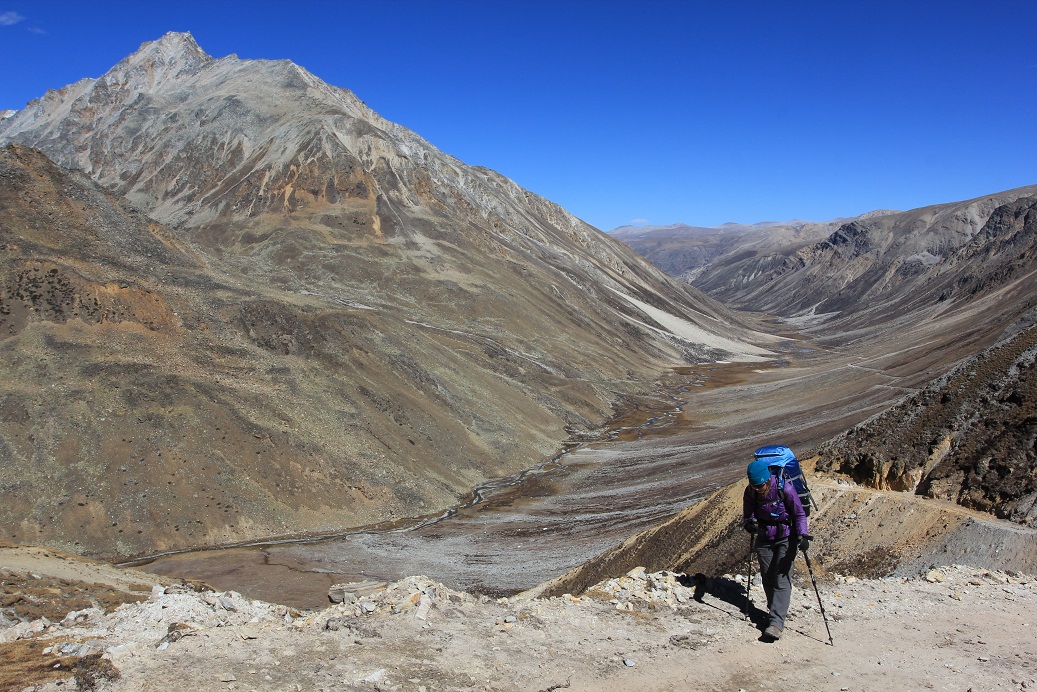
I feel like running the marathon, exhausted but still 5km until the finish. Every step up it takes, my lungs cry for oxygen and my muscles cry for help. 200m ascend until the 5100m Kagmara La pass is reached. I’m allready higher then any possible summit in the Alps, but the ridges and gloaming peaks around me just laugh with that thought.

Near the Kagmara La, Dolpo, Shey Phoksundo NP, Nepal

Near the Kagmara La, Dolpo, Shey Phoksundo NP, Nepal

I still cannot distinguish the prayer flags at the pass for which I long so much. A golden eagle swoops without any effort in a thermal. My thoughts swing away back to Simikot, which we left in the hot, baking sun 2 weeks ago, with a compass heading south-east.

A farmer with his cattle herd on the small trails along the Humla Karnali river, Humla, Nepal

A farmer with his cattle herd on the small trails along the Humla Karnali river, Humla, Nepal

We were about to follow the turquoise Humla Karnali-river into the Mugu-district. At lower elevations (we descend into the Middle Hills at around 1500m-2000m), the ever rising and plunging down along the river was easier to digest.

Through the Humla Karnili gorge towards Mugu-district

Through the Humla Karnili gorge towards Mugu-district

Dense, mixed, conifer, birch, oak, walnut and rhododendron forrest are opened up only for some of the most primitive villages we have ever been through. Huge cannabis plants border the wheat fields and spread with a small breeze its deep, sweat smell over the trail.

Dal bhat with fresly dried goat meat, Surkeghat, Humla, Nepal

Dal bhat with fresly dried goat meat, Surkeghat, Humla, Nepal

Time has come to a halt here centuries ago. Children don’t beg for balloons, pens nor chocolates in the villages of Dharma and Rimi. Englishis is an unknown language. It’s half-way october and the fields shine like gold. Harvest is closing-in soon now. This time of the year people can feed themselves (and us). We do not want to imagine how life must be here after winter when all food is gone. Life is harsh here in Mugu. Tourism is below infancy. The Great Himalaya Trail will hopefully boast the region in some way in the coming years.

Children run along, when we walk through Rimi-village in Mugu. They keep chanting namaste untill we dissapear in the forrest far away from the village.

Children run along, when we walk through Rimi-village in Mugu. They keep chanting namaste untill we dissapear in the forrest far away from the village.

The scenery changes with every curve of the river altough in this part of Nepal you will not find the extreme, high 8000m fluted peaks for which the Himalaya is known. Walking here is a flash back in time, where modern world has not touched down yet. People are poor and underdevelopped, but that ever welcoming smile burries ever such taught.

The Mugu Karnali River joins the Humla Karnali further south, dropping out of the HImalaya into the Ganges Plains in India.

The Mugu Karnali River joins the Humla Karnali further south, dropping out of the HImalaya into the Ganges Plains in India.

We cross the suspension bridge over the Mugu Karnali river and step into a dinstinct world. Gamghadi is a radical change. Everybody is preparing for the Dasain-festival. Painting is going on. And a gravel road construction is on the way from Jumla, 3 days walking away. It’s an up and down of mule caravans on the steep forrested trails, transporting out the famous red rice, cultivated in Mugu, and bringing in consumer goods, transported into the region via the only road, which ends in Jumla.

Jumla-streets are filled with goat and sheep blood, as villages people sacrifice for the Dasain-festival, the main celebration of the Hindu year.

Jumla-streets are filled with goat and sheep blood, as villages people sacrifice for the Dasain-festival, the main celebration of the Hindu year.

In Jumla we hire 2 new porters before setting of for Nepal’s least inhabited district: the mystical Dolpo. Fortress-like settlements are very scattered, so we need to carry more food and kerosene. Dolpo, like the Limi-valley, is tied culturally to Tibet. Budhism is the way to go. Manis, stupas, gompas and prayer-flag ornated monasteries. Dust-throwing yak caravans are just mere dots in the arid red-rolling mountain desert, set against ever blue skies and radiating sun.

Thick forrested ridges before climbing onto the Dolpo desert

Thick forrested ridges before climbing onto the Dolpo desert

Huge stands of cannabis plants at the entrance of Chaurikot, Dolpo district, Nepal

Huge stands of cannabis plants at the entrance of Chaurikot, Dolpo district, Nepal

Exhausted I reach the 5100m Kagmara La and I fail miserably in limbo dancing the prayer flags (not recommended in thin air). Another steep walled valley splunges down in front of me. This is the Shey Phoksundo National Park, encompassing the major part of the Dolpo district.

Kaghmara Pedi bivaouc, 3900m, Shey Phoksundo NP, Dolpo, Nepal

Kaghmara Pedi bivaouc, 3900m, Shey Phoksundo NP, Dolpo, Nepal

Herds of blue sheep jump the ledges of an impossible steep, granite wall above our bivaouc spot. They are the main food source for the magical, mystical, elusive snow leopard. Under a full moon we fall asleep under the tarp (yes it works in the Himalaya above 4000m!), while the howl of a wolve reminds us of our remote, wild whereabouts.

A wild dog followed us closely for 3 days over the 5100m Kagmara La pass. In the first village we cross, he lost interest in us.

A wild dog followed us closely for 3 days over the 5100m Kagmara La pass. In the first village we cross, he lost interest in us.

We reach the deep, blue Phoksundo Lake at medieval Ringmo village and visit the ancient Bon gompa at its shores.

Bon Gompa at the shores of Phoskundo Lake

Bon Gompa at the shores of Phoskundo Lake

As we still have not enough for this stretch of the Great Himalaya Trail, we cross the 5100m Baga La pass and 5300m Nama La pass in a tyring and cold 48-hour stretch. The scenerey get more arid with every step we take now. As for high altitude desert, they surely have thrown with superlatives here. It is hard to soak on in all the views here. My brain is too small for this huge landscape.

Leaving Ringmo village, with an impressive stupa garding its entrance

Leaving Ringmo village, with an impressive stupa garding its entrance

The fluted Kanjiroba Himal to the northwest hides the world’s remotest valleys for which we should return one day when its acces permit hopefully may be less steep. At the southern horizon 8000-peak Dhaulagiri blocks the monsoon rains and to the north the vast Tibetan plateau still awaits its freedom.

Yak caravan storming its way down from Baga La, 5100m, Phoksundo NP, Dolpo, Nepal

Yak caravan storming its way down from Baga La, 5100m, Phoksundo NP, Dolpo, Nepal

Collecting specimen of Thamnolia vermicularis Lichen for the Adventure & Science project

Collecting specimen of Thamnolia vermicularis Lichen for the Adventure & Science project

We plunge into the Tharap valley, which must be the perfect resume of what forbidden Tibet must be all about. A steep, wild gorge brings us back to thicker air and greener valleys where a flight from a frightning airstrip in Juphal brings us back to the lowlands and into the splurges and hot shower of Kathmandu.

A dusty yak route into remote Tibetan Dolpo

A dusty yak route into remote Tibetan Dolpo

The Dhaulagiri-chain blocks the monsoon rains from the south

The Dhaulagiri-chain blocks the monsoon rains from the south

The impressive Ribo Bumpa Gompa, high above the Tharap Valley, Dolpo

The impressive Ribo Bumpa Gompa, high above the Tharap Valley, Dolpo

We are gearing up for a 5-week Rolwaling-Khumbu Alpine traverse for which we will need to cross glaciated 5750m Tesi Lapcha, 5780m Amphu Lapcha and 5415m Mera La passes. On the way we do an attempt on 6476m Mera Peak.

See you back here around X-Mass.

Namaste
Steve and Katrijn

Thin air dreamers...

Thin air dreamers…

Please have a look in our online photo album from our first 6 weeks in West-Nepal.

You can still follow us real time up here.

The Great Himalaya Trail – a pilgrimage of the soul

Buckle up, earplugs in. A deafening roar. A breath away we hoover in a small twin otter above the fog between steep forested mountains. The rising sun blinds our eyes through the small cockpit windows. 2 pilots. 5 passengers of which 2 dreamers for mystical high valleys and roaring peaks.

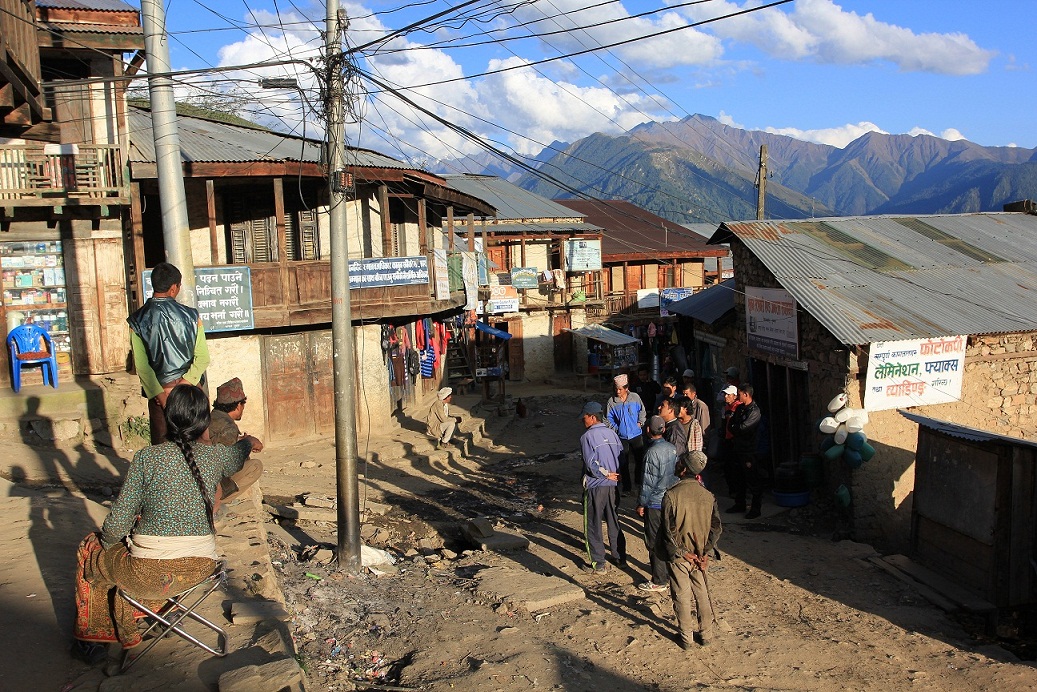
Main Bazar of Simikot, capital village of Humla District

Main Bazar of Simikot, capital village of Humla District

A 50 minute, impressive flight would bring us from the hot and soaking lowlands into the heart of remote, western Nepal. Right into the heart of the world’s highest mountain chain. The Himalayas. Before we realize, we see an airstrip appear through the cockpit’s window. Touch-down Simikot. At almost 3000m asml, the capital village of Nepal’ highest, northernmost and most remote district Humla.

Smokin' fresh tobacco from the fields

Smokin’ fresh tobacco from the fields

The sprawling village has no road access. It takes 14 days walking to the closest road head. This closed-off corner of the world, deep in the Himalayan mountains is carpeted with centuries-old migration paths in and out Tibet, just a stone throw away.

Pen. Chocolate. Mister. Mister...

Pen. Chocolate. Mister. Mister…

We have the intention to backpack in 3 months a considerable distance of the Great Himalaya Trail, which is in contrast to famous long distance trails in Europe or the States, more a suggestion for a traverse along the world’s highest mountain chain, extending through Pakistan, India, Nepal and Bhutan. The “trail” is an unmarked nor signposted route of which you pick and mix your way out of the web of paths through and over the roof of the world.

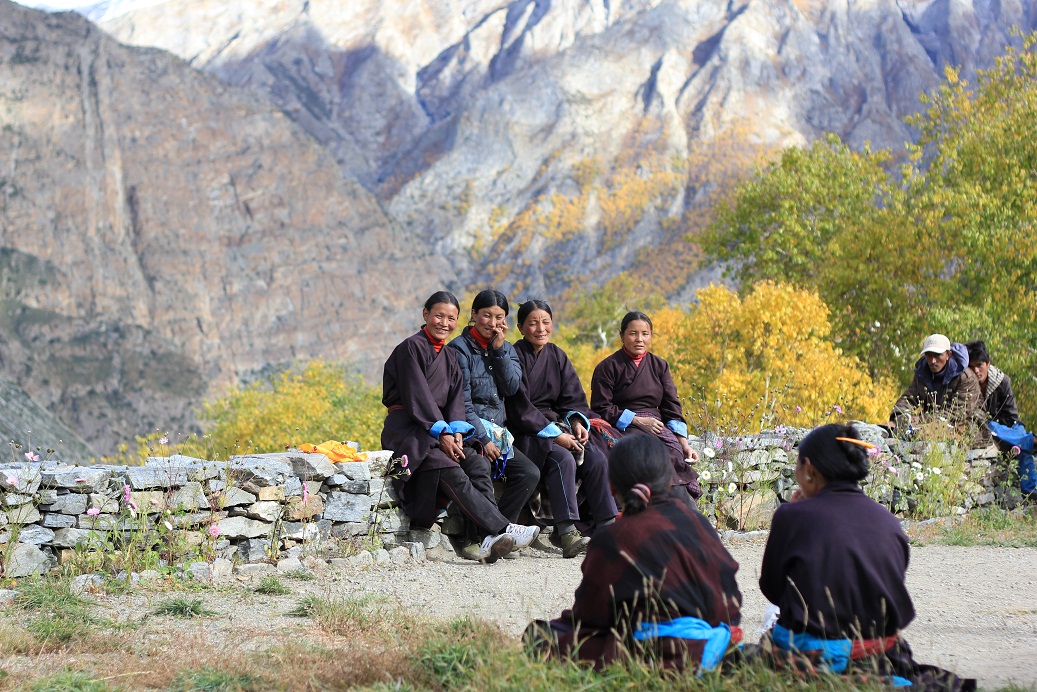
Colourfull women in Daurapiri, Humla Karnali

Colourfull women in Daurapiri, Humla Karnali

The philosophy behind the trail is to attract trekkers to more remote parts of the Himalaya, where tea house trekking is till a far away known. Its goal is to attract visitors to under-developed and impoverished areas where only few alternative development opportunities exist.

Visiting the doctor in the Health Office from Nepal Trust in Palbang

Visiting the doctor in the Health Office from Nepal Trust in Palbang

We have chosen to explore the more forgotten and hidden valleys, passes and peaks, with the intention to support the local people as much as possible. We did not bring a an expedition crew of porters, carrying kitchen tents and food from far away to cook on campsites in between the villages.

Yak caravan. Humla Karnali.

Yak caravan. Humla Karnali.

In stead we come lightweight, in-Himalayan style, carrying our own gear. Ram, our guide, leads us through the web of ancient old, bad mapped caravan routes and to handle language barriers with all the different ethnic groups of which cultural differences vary from one valley into another.

Climbing up to the Limi Valley with the Hilsa border post down-valley

Climbing up to the Limi Valley with the Hilsa border post down-valley

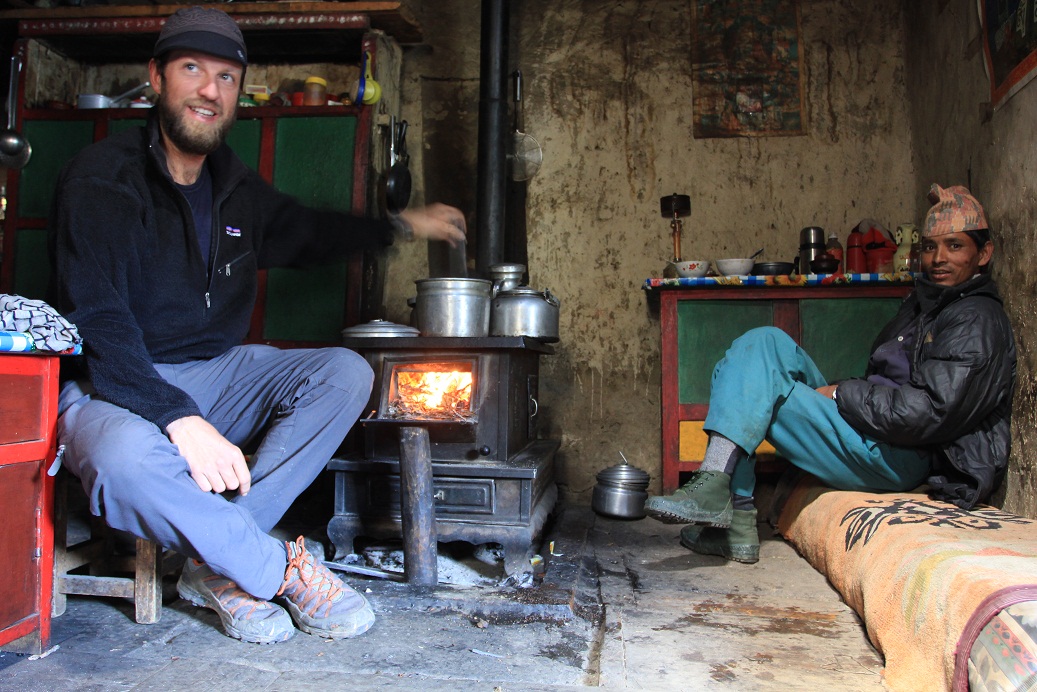
In the spirit of the the Great Himalaya Trail, we will stay as much as possible with the people, share their table and sleep in their room or on their roof. In the far western part there is nothing yet resembling a tea house or anything worth naming a tourist facility.

Trails carved up impossible steep valley walls, Limi Valley

Trails carved up impossible steep valley walls, Limi Valley

More then once we are invited to stay with families who never had a stranger over the floor. Sometimes distance between the villages would be more then a day walk away so we hire a local porter for carrying some camping food into thin air and wind swept passes.

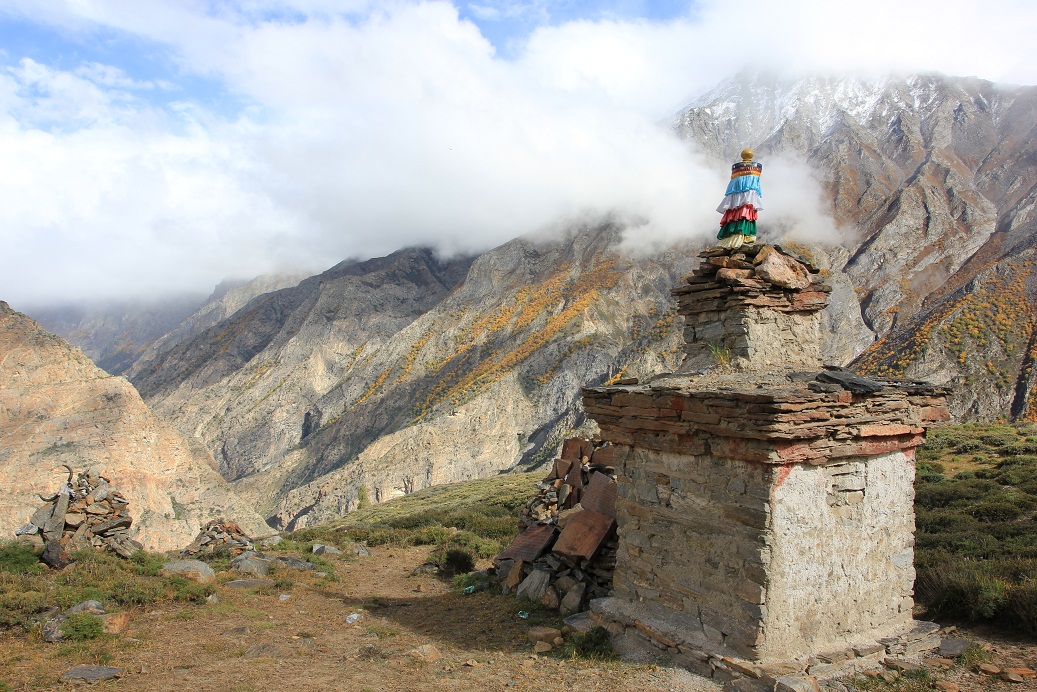
Charten, high above the Limi Valley

Charten, high above the Limi Valley

We follow yak and mule caravans towards the Tibetan border through the fertile Humla Karnali valley, along medieval stone-build villages. The sound of the wind is broken by women chanting ancient Tibetan songs while harvesting the barley fields. We’d greet “Namaste” to young men wearing the “HortN” Face (no kidding!) jackets and send off “pen” and “chocolate” begging children to school.

Yak butter thea? Noboddy?

Yak butter thea? Noboddy?

The sun burns our pale skin while air is getting thinner. In Hilsa, at the border with Tibet, Nepali’s most northwestern border point with Tibet and Nepali’s Great Himalayan Trail western entry point, we swing up even more north into the Limi Valley, only open to foreigners since 2002. A steep trail is cut high up into an impossible looking valley wall, high above the roaring Karnali river.

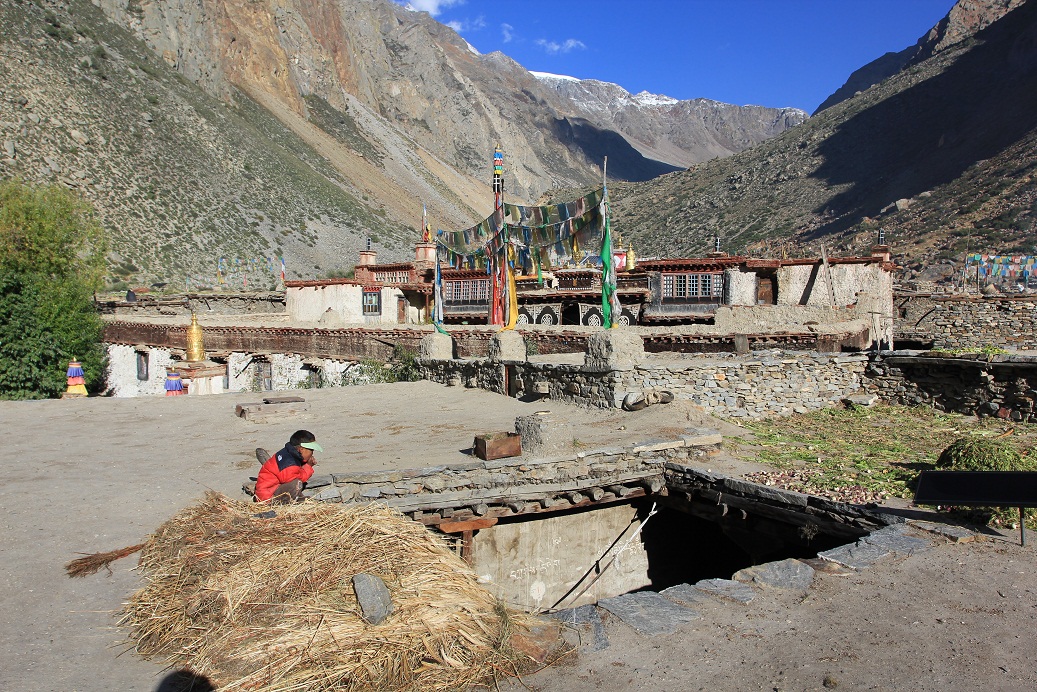
Rooftop terrace. Til village. Limi Valley.

Rooftop terrace. Til village. Limi Valley.

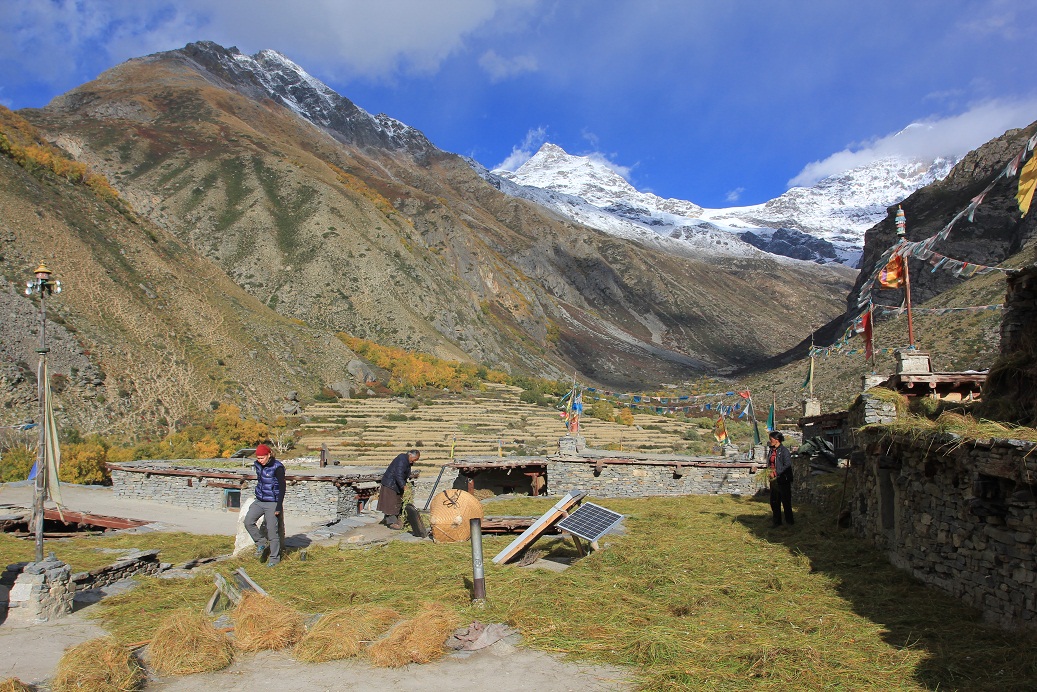
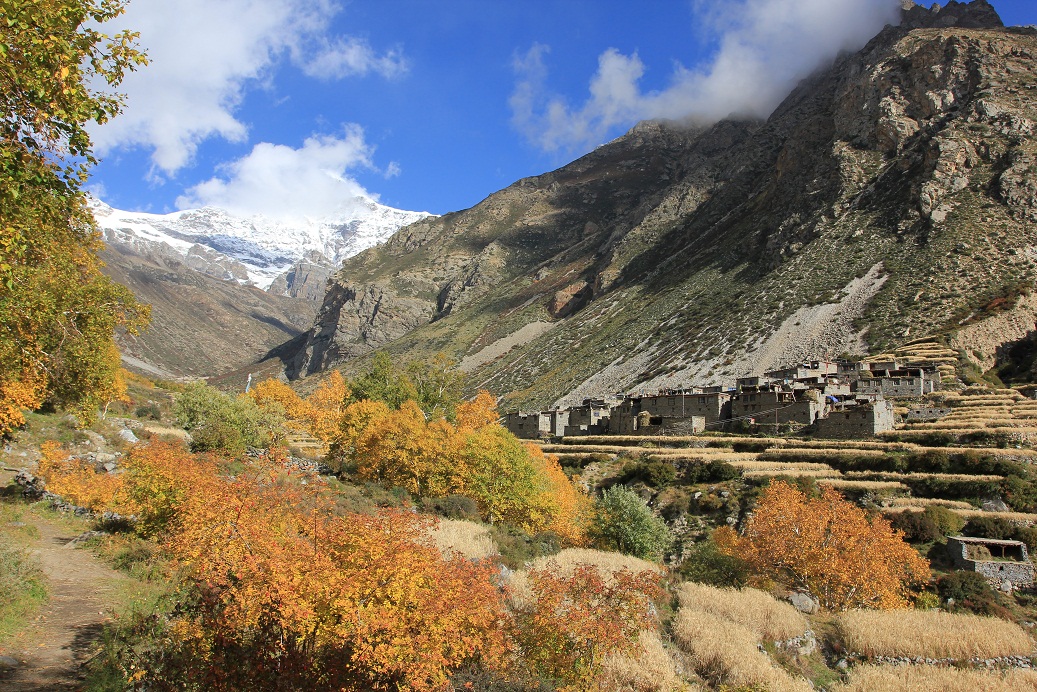
These steep mountains didn’t stop human looking for living grounds but surely it kept industrial revolution get through. People live on the rythm of day and night, living to live and survive on their own. Development stopped here a couple of centuries ago. Til, Halji and Jang represent villages out of medieval times.

Women of Til village, awaiting the school sponsor

Women of Til village, awaiting the school sponsor

Kids would flock around us and touching us endlessly as we were new toys when we enter the villages. In Til and Halji we sleep in the house of the Lama and visit their 5 centuries old, impressive monasteries.

Til village. Shangri-La?

Til village. Shangri-La?

We encourage the work of some NGO’s, building primary schools, health offices and micro-hydro and solar power into these villages. But in our short time here we discover pathetic flaws into some of their work. Building a health post stocked with pills and to post the place with a flew-in doctor a couple of weeks a year will make things better right?

Children of Halji. Limi Valley.

Children of Halji. Limi Valley.

Close to the health post of Hilja, down by the Karnali river, we discover remnants of half-burnt stacks of out-of-date pills in easy reach of children’s hands. A sign at the health office promises to bring basic health education here but in the village the families don’t have even the slightest clue about basic sanitation. Toilet? Euhm. Out of the village, down by the river. We’re 10 years behind the inauguration of the health office…

Impressive 500-year old Gompa. Halji village. Limi valley.

Impressive 500-year old Gompa. Halji village. Limi valley.

Building a primary school with foreign money. Check. An educated teacher. Check. School furniture. books and utensils. Not so always check. The “sponsor” is doing his yearly tour along the villages. A nice good-looking American, handing out useful and not so useful gifts. Continuing to the next village. Nice? Euhm. But why not checking if the kids really have learn something?

Waving goodbye. Children of the head lama of Halji village. Limi Valley.

Waving goodbye. Children of the head lama of Halji village. Limi Valley.

Solar panels and micro-hydro power. A couple of years later. Half of it in decay. Continuation? And that while famous NGO-representatives sipping expensive bears and chicken wings far away in their nicely built office in Simikot.

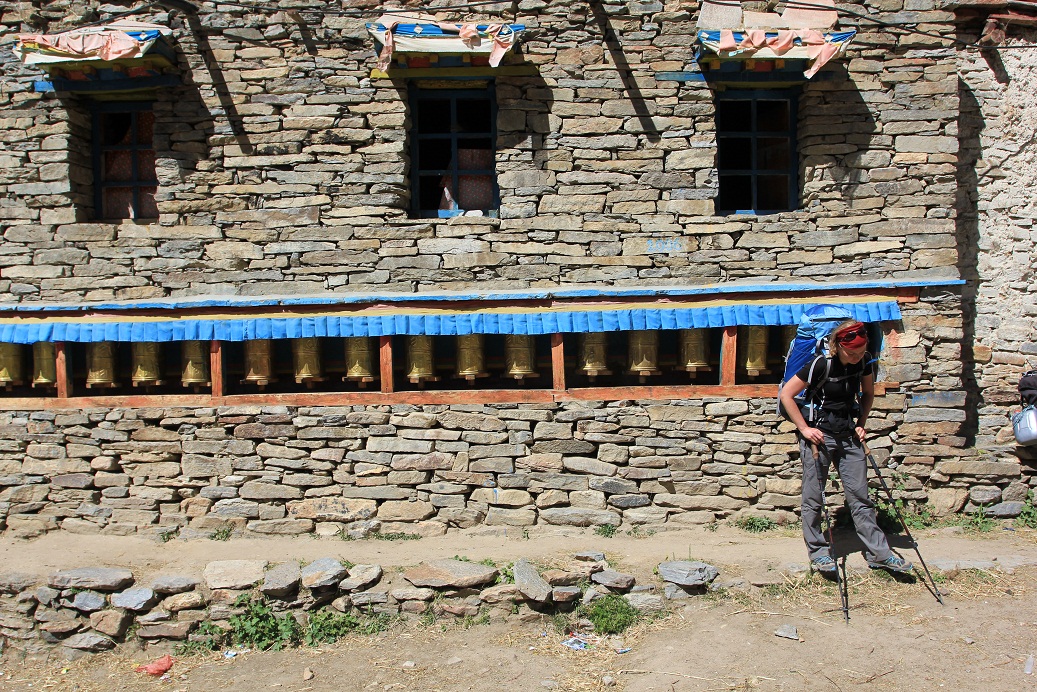
Prayer Rolls at the entrance of Yang village monastery. Limi valley.

Prayer Rolls at the entrance of Yang village monastery. Limi valley.

Incredible Milky Way. Bivaouc at the foot of Nyula La pass (5000m).

Incredible Milky Way. Bivaouc at the foot of Nyula La pass (5000m).

River crossings. Still awesome. Especially at 4500m asml.

River crossings. Still awesome. Especially at 4500m asml.

Rural Nepal, ranked in the top 10 of poorest parts in the world needs true and continues development. It needs honest NGO’s with an honest, lasting plan. And a stable, corruption-free government. There has been done great work here, but still…
It all starts with educating the people, young and old.

Climbing up to Nyula La (5000m). Tibetean plateau in the background.
Climbing up to Nyula La (5000m). Tibetean plateau in the background.

Coming down from Nyula La (5000m). Unscaled, unnamed virgin 6000m peaks in the background.

Coming down from Nyula La (5000m). Unscaled, unnamed virgin 6000m peaks in the background.

Heading down back to Humla Karnali Valley.

Heading down back to Humla Karnali Valley.

We’re only 14 days off in the Nepali Himalaya. It already carved a deep impression. It’ a pilgrimage through the highest mountains and deepest valleys of the soul.

We’re heading east now. Into Mugu and Jumla and through Dolpo.

Namaste.

Steve and Katrijn.
Dreamers on the go.

Dreamers on thin air. Humla Karnali. Nepal.

Dreamers on thin air. Humla Karnali. Nepal.

You can still follow us real time up here.

Packrafthike Gap Year – Part 1/The Subarctic

[Update Tuesdag 11 July 2012 – MAJOR UPDATE on the first Sarek part, where we choose to cut through in western direction in direction of the Norwegian coast, right through Padjalenta National Park, packrafting the anciant glacial lakes of Virihaure, Vastenhaure, Sallahaure. 2 more days added on Lofoten. 2weeks till kick-off. First we’ll have a 10-day family retreat on Tenerife (Canary Islands). Download the full google earth map below]

Seamsealing the MLD eVent rain mitts, a monastic work.

Seamsealing the MLD eVent rain mitts, a monastic work.

We would like to present Part 1 of the Gap Year. A 1102 km packrafthike in Norhern Sweden and Norway. All above the Arctic Circle, wider known as Lapland or Sápmi . 745km hiking. 357km packrafting. 55 days. Kick-off 25th July. Finale 17th September.

The first part includes passing through known and less known areas like Tromsdalen, the Lyngen Alps, Kitdalen, Breiddalen, packrafting Kummaeno, Taavaeno and Lainio in remote Northern Sweden, smashed in between Finland and Norway. A second part will bring us to the famous Kebnekaisefjällen in the Swedish fjells along the Kungsleden, packrafting south, passing a first time through Sarek, westwards through Padjalenta. There we will ferry towards Versteralen and Lofoten. Those islands sparked us with so much eager last year, that we had to come back for some packraft-floating in between the needle-like granite peaks emerging from the sea. We will ferry back towards mainland, from where we will traverse the Svartissen and Salfjellet National Parks in coastal Norway. We will cross back to Sweden in eastwards direction towards wildlife-cladden Taradalen, from where the ruska (autumn) coulours will daze us. From here we will enter a second time into Sarek with an intention on packrafting Rapadalen.

We expect subarctic, summer-autumn climate conditions : ****-loads of misty rain, snow, cold, low clouds on the windswept tundra, arctic mountains and a mosquito-laden taiga. Hopefully some sun too. Would be nice. Thank you.

Please click here for a google earth download file from the 55-day plan. We embed the map in google maps below, but google maps crops everything in 3 different pages, so you don’t have the full picture here.

We would appreciate it a lot, if people known to and from the area, and especially on packrafting some of the rivers, fjords or seas, if they could give us some feedback through the comments. Maybe we overexagerate on some (packrafting) parts of the plan. Or maybe we should reconsider alternatives, on which we did not set our eyes on. A gear list will appear here soon too.

Packrafthike Planning Lapland 2012

Packrafthike Planning Lapland 2012

50 Days Food Rations Preperation

50 Days Food Rations Preperation

We known the area only from winter trips. We were on the Lofoten last year. Loads of pics will follow. We hope.

Utakleiv Beach - Lofoten Islands (from our april 2011 visit)

Utakleiv Beach – Lofoten Islands (from our april 2011 visit)

Reine, probably the world's most photoscenic village. Southern Lofoten Islands (from our april 2011 visit)

Reine, probably the world’s most photoscenic village. Southern Lofoten Islands (from our april 2011 visit)

Plan, pack light, travel, hike, raft… a gap year rehearsal

Since our last trip into Sarek it has been quite hectic, to say the least. It’s hardly possible reaching the kitchen from the bedroom. Maps, gear, boxes and dust scatter the house. Our cat is roaming around the house, but seem not to find her peace. There is a growing suspicion towards the 2-legged-ones. What the heck are you guys doing? Are you moving out? Or you going to leave me behind? This leads to more scratches after the usual evening coddling.

Packing for a general rehearsal on hiking and packrafting in the Alps - click for more details

Packing for a general rehearsal on hiking and packrafting in the Alps – click for more details

This isn’t preparing for a regular trip. This swallows every second of free time. We’re 6 weeks away from a gap year of a packraft-thruhiking adventure on 3 continents. With legs hanging we shoveled to our bosses for an aproval letter for a career interuption. You enter the office and close the door behind you. They already know how late it is. We’ve been there before. It’s times like these, when unknown facial expressions uncover. Thank you Els and Tim, loving bosses, for aproving us to live our dream.

Climbing up to the snowy pass, on a quest for the Lech River.

Climbing up to the snowy pass, on a quest for the Lech River.

We are in an unceasing quest of organising, checking, testing, evaluating, discussing our gear. Yeah I have been spending hours, days, weeks, months bent over maps. That’s fun and quite easy. Mapping, planning and organizing is 1. But gear considerations is the uttermost important part of the preperation. And small 3-4 day mini-adventures to keep the quest and finetuning going. i have been promising gear reviews here. They will appear. Deadlines, I hate them.

Scouting for a packraft put-in along the Lech River

Scouting for a packraft put-in along the Lech River

Since 2 years we made a complete switch from classical backpacking to lightweight. Pack light. The key issue for the plans we have in mind for the gappy year. Previous backpacking trips in wilderness areas made us realize we need something to overcome that frustrating problem. Besides that we didn’t want rivers, lakes or fjords to be an obstacle anymore. During 2 months Arctic Scandinavia and 5 months Patagonia, we will haul our Unrigged Explorer Packraft. Volume, weight, durability, funcionality. Always a discussion. We’ll need a framed pack for the mentioned packrafting destinations. There going to be streches of hiking/rafting on which we will need to carry gear and food for 14 days without resupply. For the 3-month thru-hiking of the Nepalese part of the Great Himalaya Trail we’ll exchange the packraft and framed pack, for a frameless pack, filled with crampons and ice axe, and a multifuel stove.

To river or not to river... packraft considerations

To river or not to river… packraft considerations

We are proud to anounce that 2 cottage manufacturarers have taken partnership with us, by providing us significant discount on their gear and food. We are not active on a search for sponsors or partners, but if you feel like 2 fools living outside for a year on some remote parts of the world is a good test case for checking functionality/durability of your cottage gear in development, just shout. We’ll glad to be a field rabbit.

Sean at Oookworks is finishing a nest for our Twing Tarp, which we will use as the only shelter for the whole upcoming year. When it arrives in the coming week you may expect an update on the blog for a first review.

The nice Dutch people at Globetrotter Outdoor Foods are helping and providing us discount on huge amounts of home-made dehydrated food for the Arctic and Patagonian part of the year. Our food drying machine just can’t handle the job alone.

In the coming 6 weeks there will be maps apearing on the site, giving you some insight on what we have planned. Please come back and have a look. If you are familiar with the areas, please give feedback.
Just like in the past we look forward on meeting new people on the way. Fresh ideas will spark alternatives. Beside that weather conditions will determine our plans. That’s for sure. Thank you weather for being bad at times. It will force us to change intentions and provide us with memorable experiences in the other option. Flexibility. You bet!

Bivaouc along the banks of the Lech River

Bivaouc along the banks of the Lech River

We look forward to a physical and mental challenge. A battle. Sometimes it’s going to be tough. Pffff what’s tough. Tough is battling to survive. Like millions of people do every day. Spoiled Western tourists. Do something extra-ordinary with your life. Hike, pack, raft… but take time for the people too. We are investigating local volunteer options in Bolivia, Peru and Colombia. That’s where we hope to end our trip between May and August 2013.

The trip report from our last general rehearsal 4-day trip has been put in video. It somewhere summarises what you might expect us doing for the upcoming year, when it’s gonna be quiet on the blog, but a little bit louder out there. That’s what you get when I get out. I can be loud. Necessary for trying to overrule them wild silences. Please push play. And have a look in the album.